Drum Tower Xi’an: Sunset Drums, the Muslim Quarter & the Perfect Bell-Tower Combo
The first time I heard the Drum Tower, I wasn’t even looking at it. I was crossing the Bell and Drum Tower Square late one October afternoon when a low boom rolled across the paving stones — then another, then another, each beat landing like a slow heartbeat. Somewhere up inside the dark timber tower ahead of me, a troupe was rehearsing the evening drum. Behind it, the smell of cumin and frying oil drifted down the street from the Muslim Quarter. I had planned to take one photo from the square and move on. Ninety minutes later I was still up there, leaning on a railing, watching the whole city turn gold.
Drum Tower at a Glance
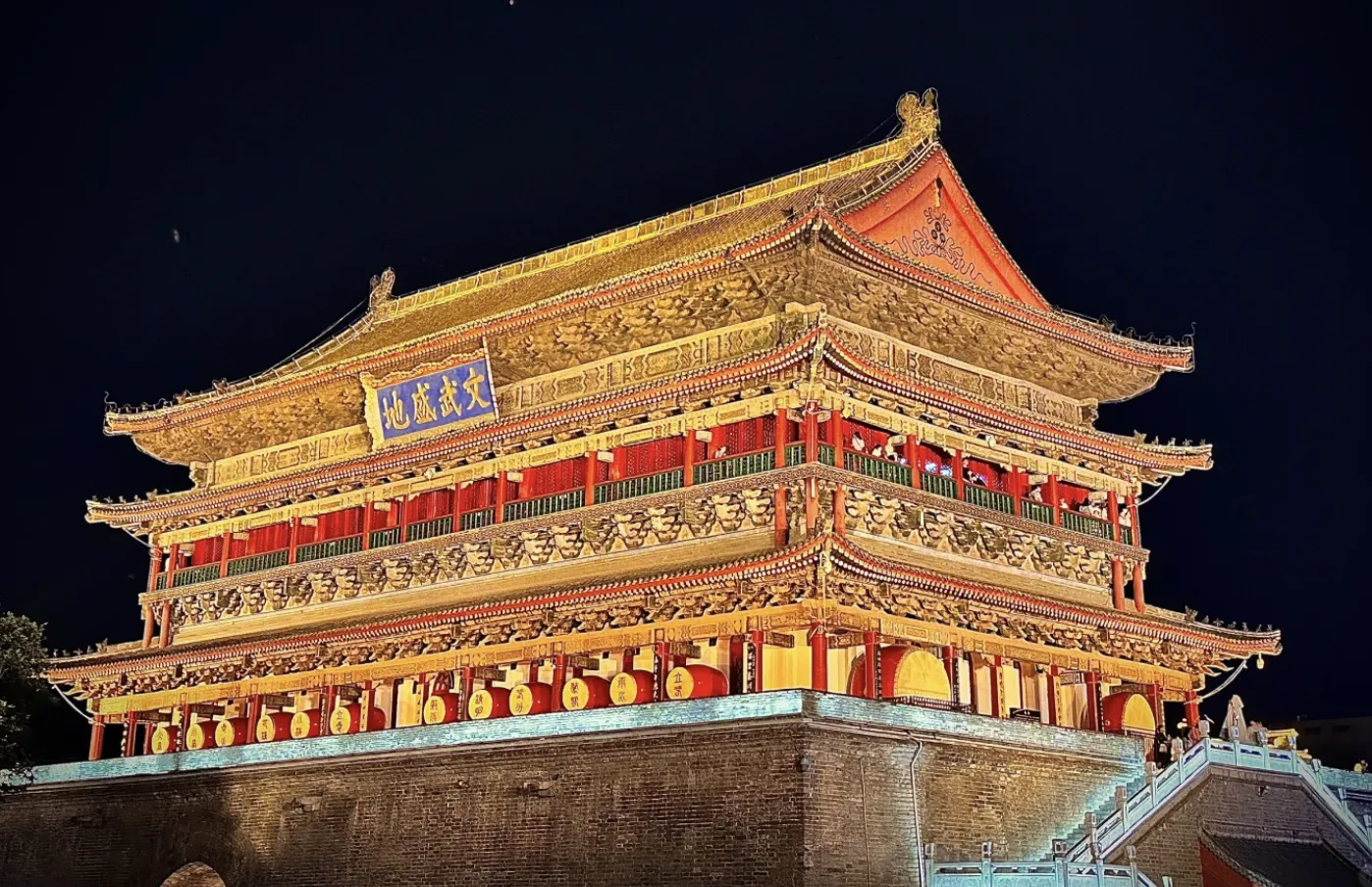
- Built: Ming Dynasty, 1380 (Hongwu 13th year)
- Height: about 34 metres — a rectangular brick base carrying two timber storeys with triple eaves
- Role: the “evening drum” (暮鼓), paired with the Bell Tower’s dawn bell in the old timekeeping system
- Location: north end of West Street, directly facing the entrance to the Muslim Quarter
- Ticket: around 30 RMB; combo ticket with the Bell Tower about 50 RMB (students usually half price)
- Hours: roughly 8:30-21:00 in summer, shorter in winter (verify before you go)
- Metro: Line 2, Zhonglou (Bell Tower) station, then a few minutes’ walk west
- Recommended time: 1-1.5 hours on the tower, then an evening in the Muslim Quarter at its feet
The Evening Drum: 640 Years of Keeping Time
In 1380, in the thirteenth year of the Hongwu Emperor’s reign, the newly consolidated Ming Dynasty was rebuilding Xi’an into a great regional capital, and it raised two towers to order the life of the city. Each dawn, the Bell Tower to the east sounded the morning bell; each dusk, the Drum Tower answered with the evening drum — a system the Chinese still describe with one phrase: chenzhong mugu, “morning bell, evening drum”. The drum marked the closing of the city gates, the end of the working day, the beginning of the night watch. For centuries, nearly every citizen of the old city ordered their day by this sound.
The tower itself is one of the largest and best-preserved drum towers in China: a brick-and-wood structure about 34 metres tall, its wooden body raised on a rectangular stone-and-brick platform roughly 52.6 metres long and 38 metres wide. What always surprises visitors is the base. The platform is pierced by a barrel-vaulted arch about 6 metres high, and through that arch — the astonishing part — traffic still flows. Cars, bicycles and pedestrians stream straight through a 640-year-old monument, exactly as they did in Ming times, when the arch doubled as the city’s timekeeping station. Look at the plaques while you stand in the arch’s cool shadow: on the south face hangs 文武盛地, “a land of civil and martial glory”; on the north face, where the lane opens toward the Muslim Quarter, hangs 声闻于天, “the sound reaches heaven”.
The tower has survived a long, hard life. It was repaired under the Qing in 1699 and again in 1740; during the Second World War a Japanese bomb snapped one of its main beams; it was restored in the early 1950s and has been a protected monument ever since. And through all of it, the markets of the Muslim Quarter kept trading at its feet. The Hui community’s lanes below have been one of Xi’an’s great commercial districts for centuries, and the drum tower’s arch is quite literally their front door — step through it and you leave the Ming-era monument and enter a living bazaar that has been feeding this city for hundreds of years.
Climbing It: Ninety Minutes Above the Old City
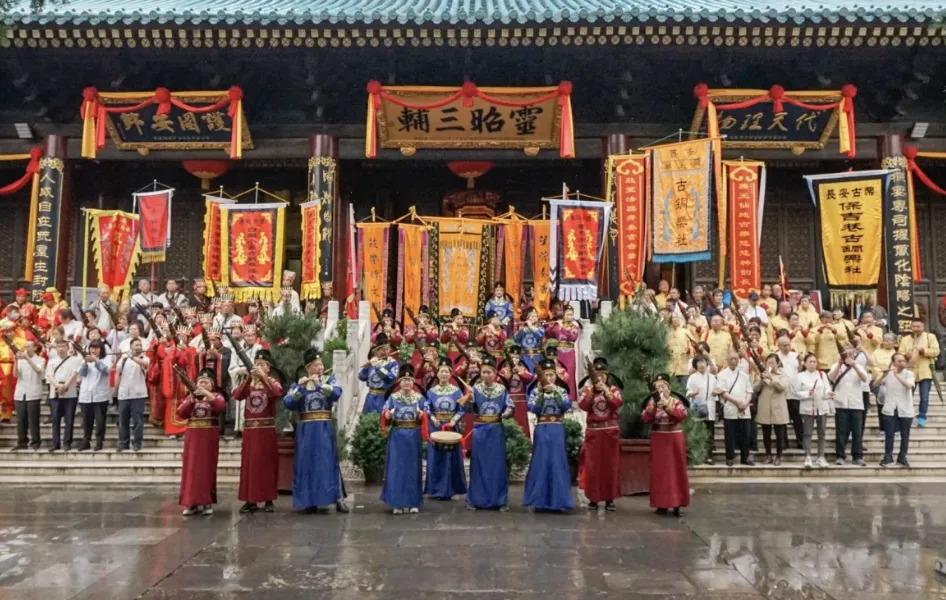
You buy your ticket in a small booth beside the arch and climb a broad wooden staircase, the treads worn soft in the middle by decades of feet. I reached the upper floor just as a drum performance was beginning, and this is the thing that no photo prepares you for: the sound doesn’t fill the room so much as travel through it. The drumbeats came up through the floorboards, up through my legs, settling somewhere in my chest. I stood at the back of the hall with a dozen other visitors and let it roll over us — fast, intricate patterns that switched without warning to single, enormous strokes.
When the performance ended, I went out onto the surrounding terrace and walked the full circuit slowly, because the view keeps changing. To the east, the Bell Tower floated above the trees of the square, its golden roof catching the last of the light. To the south, West Street ran away between modern shopfronts. And to the north — this is the view that stays with me — the old city spread out in grey tiled roofs, and above the nearest of them, columns of cooking smoke rose from the Muslim Quarter below, where the evening rush was just beginning. Somewhere down there a stall was frying something that smelled like cinnamon and sesame.
Inside, the tower doubles as a drum museum. The centrepiece is the Wentian Drum (闻天鼓), a giant red drum whose head is bigger than a dining table, and beside it stands a row of 24 vermilion drums, one for each of the traditional 24 solar terms, each painted with the character of its season. Visitors are allowed to strike smaller replica drums, and the hall rings with the amateur thumping of kids and grown-ups alike. A separate room holds a collection of Ming and Qing furniture — carved rosewood chairs and lacquered screens — a quieter, dustier sort of time travel after all that noise.
Inside the Tower, Piece by Piece
- The vaulted arch and base: the living part of the monument — traffic still passes through the 6-metre arch today. Stand here at dusk and watch the Ming-era masonry frame the modern street. The plaques 文武盛地 and 声闻于天 are on this level, one on each face.
- The drum culture exhibition: the hall that holds the giant Wentian Drum and the 24 solar-term drums, plus drums from different eras and ethnic groups of China — an unexpectedly thorough little museum, worth a slow lap.
- The Ming and Qing furniture hall: carved wood, lacquer and ink paintings, a quiet side room that most visitors rush past.
- The upper terrace: the reason to climb at all — a 360-degree promenade over the old city, with the Bell Tower on one side and the Muslim Quarter on the other.
- The Muslim Quarter gateway: the arch on the north side opens directly onto Beiyuanmen, the main drag of the Muslim Quarter. There is no “exit to the food street” to find — the food street begins at the tower’s own foundation. The quieter parallel lane, Beiguangji Street, is a few steps west.
Practical Guide: Tickets, Hours & Getting There
Tickets: about 30 RMB for the Drum Tower alone, or about 50 RMB for the combo ticket covering both the Drum Tower and the Bell Tower — the towers are a few minutes’ walk apart, so the combo is the sensible option for almost everyone. Students and seniors usually get discounts, and children are often free; carry your passport or ID. Prices do change, so treat these figures as a guide and check the official channels before you buy.
Hours: roughly 8:30 to 21:00 in summer, with the ticket office closing about half an hour before the tower itself. In winter the hours shorten, sometimes to around 18:00. Evening visits are the highlight of the tower’s day, so check the closing time before you plan a sunset climb.
Getting there: the easiest route is Metro Line 2 to Zhonglou (Bell Tower) station, then a few minutes’ walk west along West Street — the tower’s arch is visible from the square. If you are coming from the Muslim Quarter, you can hardly miss it: the main street runs straight into the arch’s north side. Between the two towers, just walk across the Bell and Drum Tower Square; it takes longer to explain than to do. Inside the tower, expect stairs — there is no lift, and the upper floor is the whole point. More city-wide tips are in our Xi’an travel tips.
Best Time to Visit
Aim for mid-to-late afternoon: arrive around 15:30-16:00, catch a drum performance, watch the sunset light climb the terrace from the upper gallery, then come down just as the tower’s lights switch on and walk straight into the Muslim Quarter for dinner. Spring (April-May) and autumn (September-October) give you the mildest weather and the clearest air, which matters on an open terrace. Summer evenings are lively but crowded — the square fills with families and street performers — while midday is hot, bright and flat for photos. Winter is cold on the open terrace but nearly empty, and the lantern-lit quarter below is its own reward.
Photography Spots
- The arch and the crowd, golden hour: stand on the north side of the square and frame the tower’s arch as pedestrians spill out of the Muslim Quarter and into Beiyuanmen — old masonry and living street life in one frame. This is the classic “Drum Tower + Muslim Quarter” shot.
- The tower after dark: floodlit against a blue-black sky, best photographed from the south side of the square, where the lights reflect on the wet paving after rain.
- The 24 solar-term drums: from the end of the exhibition hall, the row of vermilion drums receding into the shadows — clean, graphic, and usually quiet enough to wait out the crowds.
- The Bell Tower from the terrace: at sunset, from the upper gallery’s east side, the Bell Tower framed between the square’s trees.
- Low angle in the arch: lie back against the base and shoot the vaulted brick ceiling with traffic blurring past — best in the last hour of daylight.
Where to Eat: The Muslim Quarter at Your Feet
The Drum Tower’s north arch is the southern entrance to the Muslim Quarter, which means the best food in Xi’an is, quite literally, steps from the ticket booth. Grilled lamb skewers over charcoal, roujiamo (the flatbread sandwich the world keeps calling a hamburger), yangrou paomo (the lamb-and-flatbread soup you tear apart with your own hands) — they are all here, along with persimmon cakes, sticky-rice zenggao and soup dumplings that burst when you bite them. I ate dinner there after coming down from the tower, and the drum I’d heard an hour earlier was still ringing in my head while I ate.
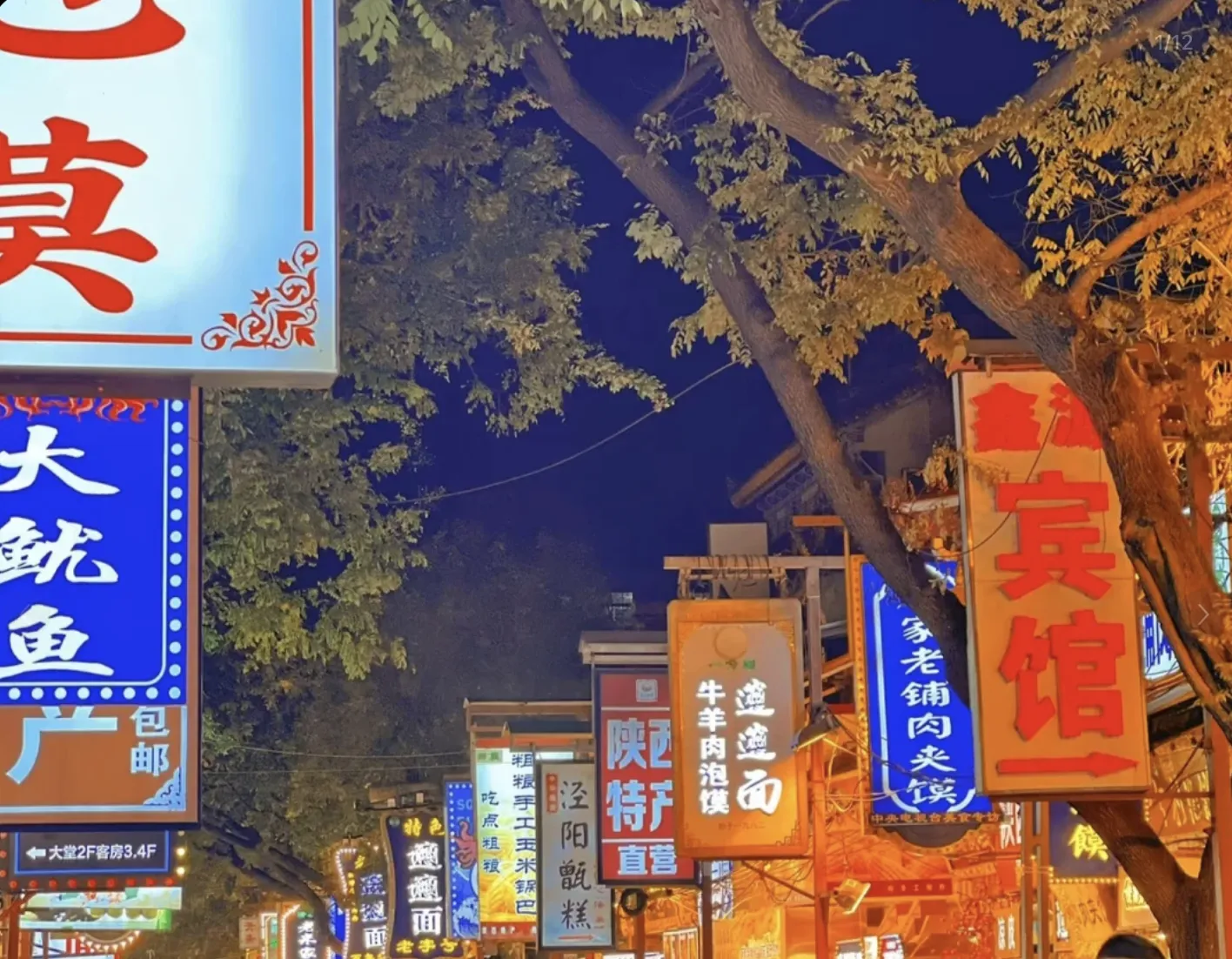
Two practical notes from a season of eating there: the main drag of Beiyuanmen is where the crowds go, but a few steps west, on Beiguangji Street and the lanes off it, the same dishes are cooked for tables of locals at a quieter pace. And arrive hungry — the quarter runs on shared plates and grazing, not sit-down dinners. Our full Xi’an food guide has the street-by-street breakdown.
How to Combine It With the Rest of Xi’an
The Drum Tower sits at the heart of the classic old-city day. Start at the Bell Tower in the morning (the combo ticket covers both), have lunch in the Muslim Quarter, then climb the Drum Tower in the late afternoon for the last performance and the sunset view. When the lights come on, either stay in the quarter for dinner or walk south toward Yongningmen and take in the city wall — the illuminated wall at night is the perfect end to the circuit. If you have extra days, the Big Wild Goose Pagoda’s evening fountain show and the Terracotta Warriors each make a strong full day of their own — see our day trip ideas for how to slot them in. A full itinerary is in the Xi’an attractions guide.
Common Mistakes to Avoid
- Arriving too late for a performance: the drum shows run several times a day, but the last one is usually mid-to-late afternoon. Check the schedule board beside the ticket booth before you buy — the drumming is the soul of this tower and you don’t want to miss it.
- Missing the last entry: the ticket office closes about half an hour before the tower, and the sunset view is the whole point. Get your ticket before the window closes, or come back the next day.
- Skipping the combo ticket: two separate tickets cost about 60 RMB in total, against about 50 for the pair — and the towers are a three-minute walk apart. Take the combo.
- Treating the Muslim Quarter as one street: the main drag is where the crowds and the pushiest hawkers are. The parallel lanes hold quieter tables and, often, better food.
- Standing in the traffic arch for photos: cars, scooters and bicycles still use it. Shoot from the side or the square, not from inside the lane.
Frequently Asked Questions
Is there a drum performance at the Drum Tower, and what time? Yes — the tower stages short drum performances several times a day, with slots spread through the morning and afternoon (mid-morning and mid-afternoon are the usual ones). Times vary by season and schedule, so read the board at the ticket office when you arrive.
How far is the Drum Tower from the Bell Tower? A few minutes’ walk — just cross the Bell and Drum Tower Square that lies between them. From the Drum Tower’s upper terrace you can see the Bell Tower clearly, and vice versa.
Where exactly is the Muslim Quarter? It begins at the Drum Tower’s own north arch — the main street, Beiyuanmen, runs straight out of the tower’s base. You cannot miss it; the question is only how long you’ll manage to resist the smell.
Is the combo ticket worth it? Almost always yes: about 50 RMB for both towers against about 30 each separately, and they’re within a short walk. Buy it at either tower’s ticket office.
Can I visit the Drum Tower at night? Yes — in summer it generally stays open until around 21:00, and the floodlit tower seen from the square is one of the best free views in Xi’an. Just arrive before the ticket office closes.
My Verdict
Xi’an is full of monuments you photograph, and this is one of the rare ones you should also just sit and listen to. The Drum Tower is a place where a 640-year-old system of bells and drums still sets the rhythm of the neighbourhood, where traffic passes through history, and where the best dinner in the city is hiding in the lanes at your feet. Give it ninety minutes and a growing appetite. You’ll leave with a drumbeat in your chest and cumin on your coat.

Guang Xiang
Guang Xiang is the founder and editor of Xi'an City Travel. Having lived and worked in Xi'an for 3-5 years, he creates all travel guides based on on-site experience - testing routes, verifying ticket details and updating prices regularly. When not researching travel content, he hikes the Qinling foothills, cycles the City Wall and explores local food in the Muslim Quarter.
You May Also Like

四川巴山大峡谷全景游玩攻略
Top 10 Things to Do in Xi’an: A Traveler’s Must-Do Guide