I rode the escalator up from Dayanta metro station at half past six on a mild October evening, and the Big Wild Goose Pagoda was simply there — a grey-brick tower rising square and symmetrical, seven storeys stacked in clean straight-edged layers against a sky the colour of peach tea. Roller-skating kids circled the fountains at its feet, a kite wobbled thirty metres overhead, and somewhere ahead a song started and the whole square seemed to lean toward the water. I had come for a quick look before dinner. Four hours later I was still there, walking down Datang Everbright City with a skewer in one hand while the streetlights came on in rows of Tang-dynasty lanterns. Xi’an has older monuments and grander ones, but I’m not sure it has a more alive one.
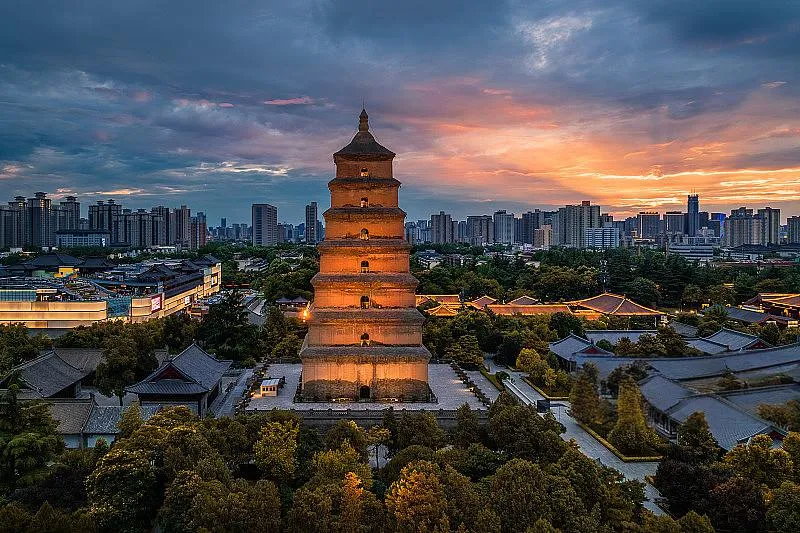
Big Wild Goose Pagoda at a Glance
- Built: 652 CE, Tang Dynasty (Yonghui reign), by the monk Xuanzang
- Height: about 64 metres, seven storeys
- Setting: inside Da Ci’en Temple, southern Xi’an (the Qujiang area)
- Temple admission: around 50 RMB (verify the current price before visiting)
- Climbing the pagoda: around 30 RMB extra (subject to official pricing)
- Hours: temple roughly 8:00-17:30
- Metro: Line 3 or Line 4, Dayanta station
- Music fountain: North Square, evening show around 20:30, free
- Recommended time: 2-3 hours for the temple and tower; give the whole evening to the fountain and Datang Everbright City
Why the Pagoda Exists: Xuanzang’s Seventeen Years
Start with the man, because the tower is his autobiography in brick. Xuanzang was born in 602, a monk by thirteen, and by his mid-twenties he was troubled: the Chinese translations of the Buddhist scriptures contradicted one another, and he wanted the Sanskrit originals. In 629 he left Chang’an without imperial permission and walked west — across the Gobi, over the Pamirs, through Central Asia and into India — for seventeen years, studying at the great monastery of Nalanda and copying every text he could find. When he returned in 645, he brought back 657 volumes of scriptures in cases, plus relics and statues. The emperor, who had refused him permission to leave in the first place, received him with full honour.
The temple came first. Da Ci’en Temple was founded in 648 by the crown prince — the future Emperor Gaozong — in memory of his mother, Empress Wende, and it was here that Xuanzang set up his translation bureau: a team of monks, officials and scholars working through the scriptures in rooms that have long since vanished. Four years into the work, he asked for something permanent. Paper and silk rot, fires happen, and the texts were irreplaceable; he wanted a tower to lock them away in. In 652 the emperor agreed, and the first pagoda rose — five storeys, a brick skin over an earth core, in the style of the towers Xuanzang had admired in India.
The first version did not last. The earth core settled and cracked, and in 701-704, during the reign of Empress Wu Zetian, the pagoda was rebuilt taller — ten storeys, so the records say. Warfare and decay shrank it again in the late Tang and the Five Dynasties, when it was brought back down to seven levels; then in 1604, in the Wanli reign of the Ming, it was given the skin of brick it wears today. So the seven-storey, roughly 64-metre tower you climb now is, in its bones, a Ming building — but the reason it stands at the centre of this city’s evening is pure Tang, and pure Xuanzang.
The name is a story in itself. In the version Xuanzang brought back from India, a small monastery was starving; a monk prayed for meat; and a wild goose — the bodhisattva in that form — fell from the sky at his feet. The monks, moved, chose vegetarianism and raised a pagoda in the goose’s honour. Xuanzang, who had seen such towers in India, carried the name home. The tower kept collecting stories: from the early eighth century the most brilliant scholars in China climbed it to carve their names — a custom called 雁塔题名, “inscribing at the Wild Goose Pagoda” — and a young Bai Juyi once wrote of being “the youngest of seventeen” on the list. In the autumn of 752 the poets Du Fu, Cen Shen and Gao Shi climbed it together, and Cen Shen’s line about the pagoda surging from the earth toward the palace of heaven is still quoted today. For most modern visitors the tower carries one more association: the Tang Seng of Journey to the West is this man, and the pagoda is the closest thing in Xi’an to the monk’s actual workplace.
Inside the Temple, Up the Tower: My Visit
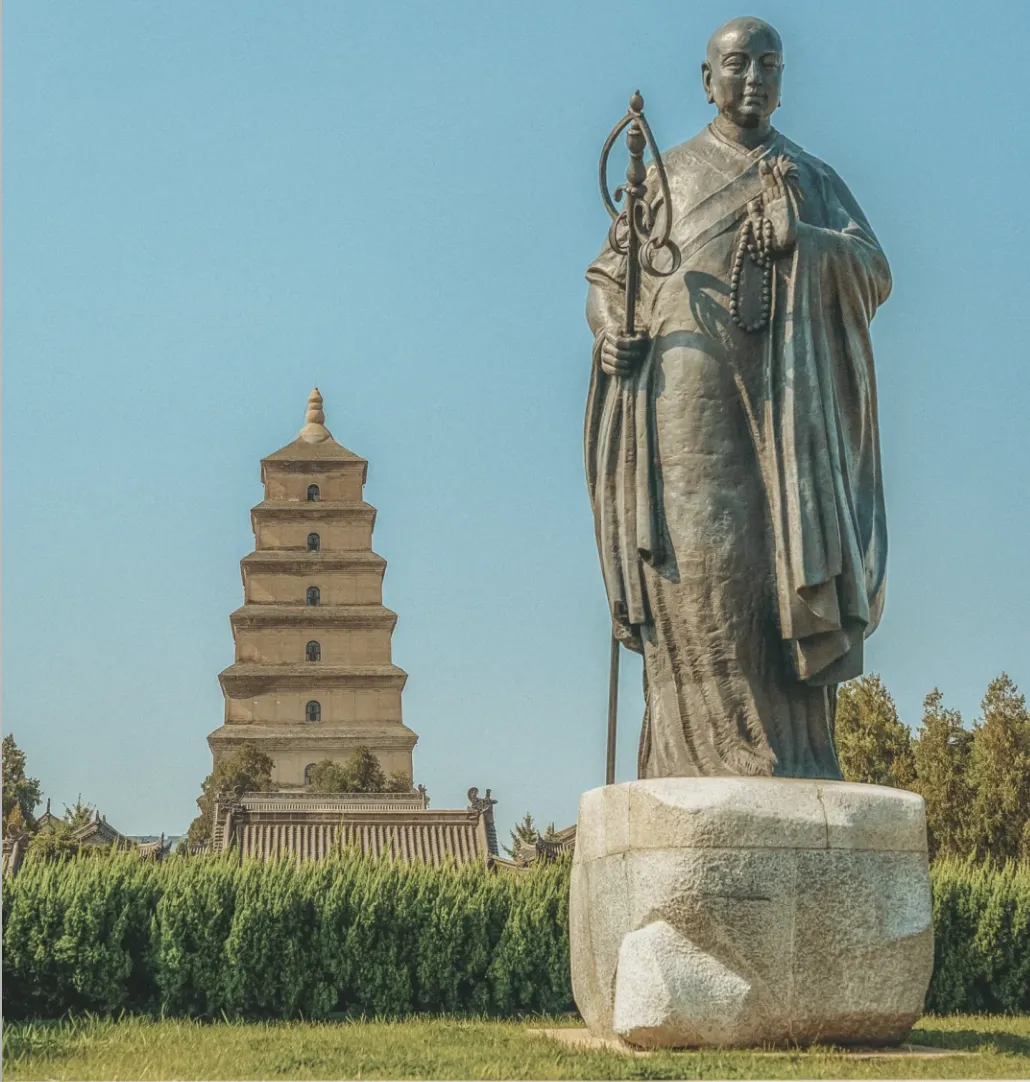
The contrast between outside and inside is the first thing you notice. On the North Square everything is loud, bright and fast — music, vendors, roller skates. Step through the gate of Da Ci’en Temple and the noise falls away like a door closing. The courtyards are planted with cypresses old enough to have shaded the Ming builders, incense rises in blue strands from the burners, and the only urgent sound is a monk in grey robes sweeping the flagstones. In the main hall, worshippers bow three times before gilded Buddhas while a priest in embroidered robes leads the chant. Off to one side, the Xuanzang Memorial Hall holds a bronze statue of the monk — staff in hand, robe gathered, the whole seventeen-year journey compressed into a single figure. I stood in front of it longer than I meant to.
Climbing the pagoda is a test of patience, and it rewards the patient. The stairs are narrow, steep and winding, wooden treads polished smooth by a thousand years of feet; the brick chambers shrink as you rise, and by the fifth storey the staircase is barely shoulder-width and light comes through windows you can lean out of. There is no lift. But the top — the top is the best geography lesson in Xi’an. To the south, the blue-grey line of the Qinling Mountains runs along the horizon; directly below, the North Square opens out like a drawing; to the north, the old city and the Bell Tower; to the west, the television tower. You can see exactly why the Tang planners put the pagoda where they did, and exactly where everything else in the city sits in relation to it.
By the time I came down, the temple was nearly empty and the square had changed clothes. The music fountain had started, and a wall of water was rising and falling to the beat — kids running through the spray at the edges, a crowd three rows deep on every side, the pagoda floodlit behind the jets. I watched two full shows before my neck got tired, then followed the current of people south through the South Square, past the great bronze statue of Xuanzang, and into Datang Everbright City.
The Pagoda’s Five Worlds, Explained
Da Ci’en Temple (大慈恩寺)
The temple deserves more than a pass-through. Give the courtyards an hour: the drum and bell towers flanking the path, the stone stele in the corner, the halls where the translation work once happened. It is a working monastery, not a film set, and on ordinary afternoons it is remarkably quiet. Short on time? The temple plus the climb is the essential two hours.
The Pagoda Climb
Seven storeys, roughly 64 metres, a tight spiral of worn wooden steps — tiring, worth it, and worth doing once. Each level has arched openings on four sides, so you can walk a slow circle and watch the city rotate around you. The tower gets steeper and hotter toward the top; bring water and be ready to give way to people coming down. Last admission ends well before the temple closes, so arrive by mid-afternoon.
The North Square & the Music Fountain
The square was built in 2003 and the fountain is its reason for being: a long run of jets and channels that rises, dances and collapses to music. Shows run through the day, but the evening performance — around 20:30, with seasonal adjustments posted at the scene — is the one everyone waits for, the floodlit pagoda rising behind the water. It is free, and it packs the square to the edges; for the classic shot of the tower over the jets, claim a spot by the front rail twenty minutes early.
Datang Everbright City (大唐不夜城)
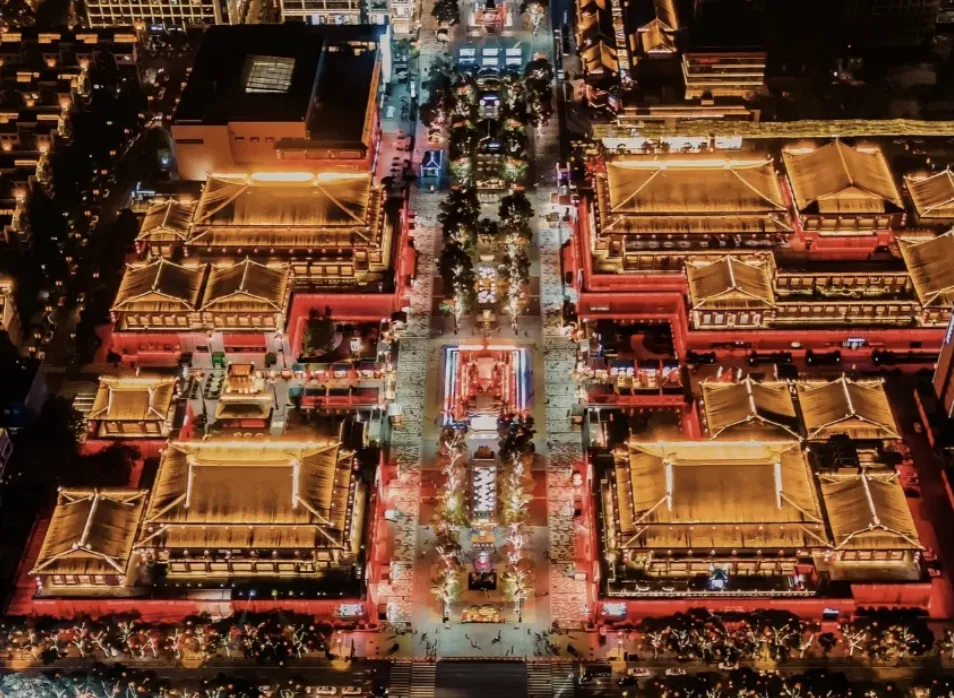
Roughly two kilometres of pedestrian street running south from the pagoda, built in the manner of a Tang-dynasty avenue and free to walk at any hour. By night it is the loudest, brightest stretch of Xi’an: facades glow, lanterns hang in rows down the middle of the street, performers in Tang costume move among the crowds — including the famous “unfalling lady”, who leans back in her basin until it seems impossible she won’t tip over. Food stalls line the way and the shops stay open late. Plan on a slow two hours.
Tang Paradise (大唐芙蓉园)
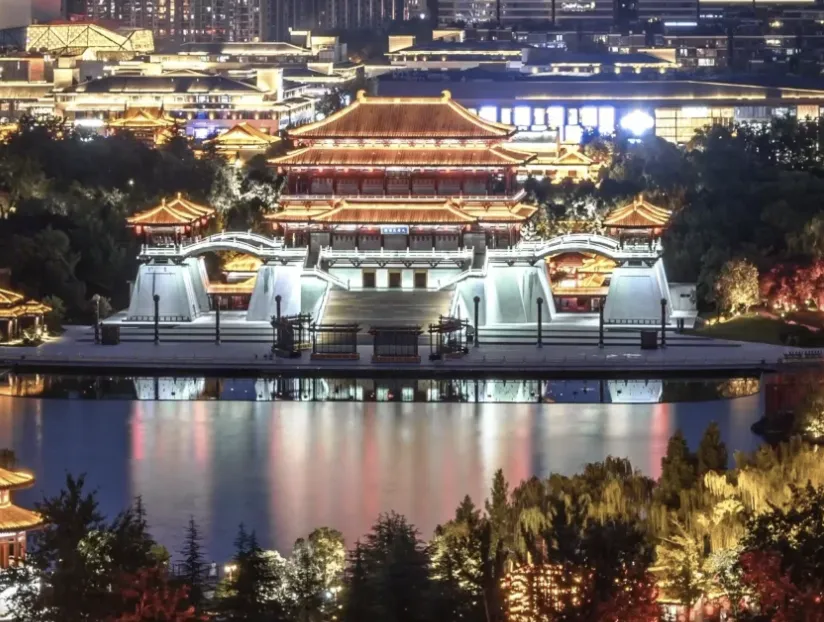
Southeast of the pagoda, across the road, is Tang Paradise — a full theme park built in the spirit of the Tang royal gardens, with the great Purple Cloud Tower at its centre and evening water-and-light performances. It is a separate ticket and a separate evening’s entertainment: if your plan is the fountain at 20:30 and the street after, save Tang Paradise for a second visit.
Practical Guide: Tickets, Hours & Getting Around
Tickets: Da Ci’en Temple — the grounds the pagoda stands in — costs around 50 RMB for adults; climbing the pagoda is a separate charge of about 30 RMB. Students and seniors usually get discounts with valid ID. Tang Paradise is ticketed separately. Prices drift, so confirm the current figures on official channels before you go.
Hours: the temple is open roughly 8:00-17:30, with last admission to the tower ending earlier — plan the climb for mid-afternoon. The North Square is open day and night, with the fountain on a posted schedule. Datang Everbright City is open late, typically until around 23:00, and costs nothing. For practical planning across the city — bookings, weather, day shapes — our travel tips page is worth a read.
Getting there: Metro Lines 3 and 4 both stop at Dayanta station; from the exits nearest the North Square you step straight into the scene. From the Bell Tower it is about fifteen minutes by metro, or a short taxi ride. Several bus routes also stop at Dayanta.
Getting around: everything here is on foot. The temple and pagoda fill a morning or an afternoon; the square, the street and the park fill an evening. For food variety, Xiaozhai — one stop west on Line 3 — has big shopping-mall food courts.
Best Time to Visit
The honest answer is late afternoon, and plan on staying until the street lights go out. The sequence that works: arrive around 15:00, take the temple and the climb while the light is soft and the tour groups are thinning, come out for dinner, watch the evening fountain around 20:30, then wander Datang Everbright City until you are tired of being impressed. In summer the whole loop is at its most spectacular after dark; in winter it is colder on the square but the lights are still on, and around Chinese New Year there are festival lantern displays.
For photographers and crowd-avoiders, morning is the quiet counter-option: the temple opens to almost nobody, and the pagoda’s eastern face takes good light before noon. Spring (April-May) and autumn (September-October) give the clearest air and the most comfortable evenings; on summer weekends the square is shoulder-to-shoulder, so go early or go late.
Photography Spots
- The classic: the central axis of the North Square, facing the tower, at golden hour or just after dark — the floodlit pagoda over the reflecting pools (the shot that opens this article).
- The fountain show: front row, low angle, camera near the ground; wait for a chorus when the centre jet goes high and the tower lights up behind the spray.
- Datang Everbright City at dusk: the moment the lanterns come on, the street stretching south in a single line of light.
- From the top of the tower: a lens through the arched window on the south side in the afternoon, when the Qinling range sits backlit and hazy.
- Tang Paradise after dark: the Purple Cloud Tower and its reflections across the lake — bring something to brace the camera.
Where to Eat Nearby
The area around the pagoda is one of the best-eating parts of the city, and the evening loop is basically a food tour with a tower attached. Datang Everbright City itself is lined with stalls and restaurants — skewers, cold noodles (liangpi), sweets like 甑糕 (jujube rice cake). A few minutes’ walk west, the Joy City mall hides serious food floors above the shops, and Xiaozhai — a short walk or one metro stop away — is a full dining district. For the classics, a sit-down bowl of 羊肉泡馍 (yangrou paomo, lamb-and-bread soup you tear the bread into yourself) or a 肉夹馍 (roujiamo, “the world’s oldest hamburger”) eaten standing at a counter are both non-negotiable Xi’an experiences. Our Xi’an Food Guide goes deeper on all of them.
My own evening ran: a roujiamo and a bowl of 甑糕 from the stalls before the fountain, then a proper restaurant for yangrou paomo afterward — tearing the flatbread into sesame-seed-sized pieces while the broth goes in is worth slowing down for. If you want dessert with a view, the Joy City rooftop terrace looks straight at the floodlit pagoda.
How to Combine It With the Rest of Xi’an
The pagoda is the anchor of Xi’an’s south side, and everything clusters around it. A natural day runs: morning at the Shaanxi History Museum — one metro stop away and one of China’s great museums, though tickets must be reserved days ahead (see our travel tips for the booking drill) — lunch in Xiaozhai, mid-afternoon at the temple and the tower, evening fountain and Datang Everbright City. If you want more, Tang Paradise fits the same evening slot, and the Qujiang Pool ruins park, a twenty-minute walk east, is a quiet green break between crowds.
Across the city, the Bell Tower, Drum Tower and the City Wall make a fine separate old-city day, and the Small Wild Goose Pagoda offers the quiet twin of this one if you have a second day in town. Keep the big day trips — Terracotta Warriors, Mount Huashan — on their own days and give the pagoda the evening it deserves; see the Xi’an Attractions Guide and our day trips pages for the full picture.
Common Mistakes to Avoid
- Assuming one ticket covers everything: the roughly 50 RMB temple ticket gets you in; the tower is about 30 RMB extra and stair-only. Budget both, and skip the tower entirely if stairs are a problem.
- Trusting an old fountain schedule: the evening show is around 20:30, but the timetable shifts by season and holiday — check the boards on the square, not a blog post from three years ago, and arrive twenty minutes early.
- Arriving at the temple at 17:00: last admission to the tower closes well before the 17:30 gate, and the climb takes 30-45 minutes. Go by mid-afternoon.
- Buying “souvenir” jade or antiques from the street: the market around the square is geared to tourists; keep purchases to food and trinkets, and buy tickets only at official windows.
- Forgetting the climb is enclosed: it is a narrow spiral with no lift — visitors prone to claustrophobia often enjoy the square and the street far more than the tower.
Frequently Asked Questions
Do I need a separate ticket to climb the pagoda? Yes. The temple is around 50 RMB; climbing the tower is about 30 RMB more. Both are subject to official pricing, which changes from time to time.
What time is the music fountain show? There are daytime shows and an evening show around 20:30, with seasonal adjustments posted at the square. It is free, and the evening show is the spectacular one.
Is the pagoda open at night? The temple and tower close around 17:30, but the North Square and Datang Everbright City are free and open late — the night scene is the whole point of an evening visit.
What is the connection to Tang Seng from Journey to the West? Xuanzang is the real monk behind the fictional Tang Seng; he translated and stored the scriptures he brought from India here. The pagoda is the closest thing to his actual workplace.
How long should I allow? The temple and tower deserve 2-3 hours. With the fountain, dinner and Datang Everbright City, plan from late afternoon until around 22:00-23:00.
My Verdict
In a city where the most famous ancient things live behind glass, the Big Wild Goose Pagoda is the opposite of a museum piece. You walk through the temple where a real monk actually worked, climb the stairs he had built, and step out into a square that has been celebrating the tower every single evening for twenty years and more. Standing on the top floor, watching the Qinling Mountains fade and the city lights come on below, I finally understood why the tower still sits at the centre of Xi’an’s idea of itself — not because it is old, but because the city has never stopped building its evening around it. Give it an afternoon and a night. You will come down with sore legs and no regrets.