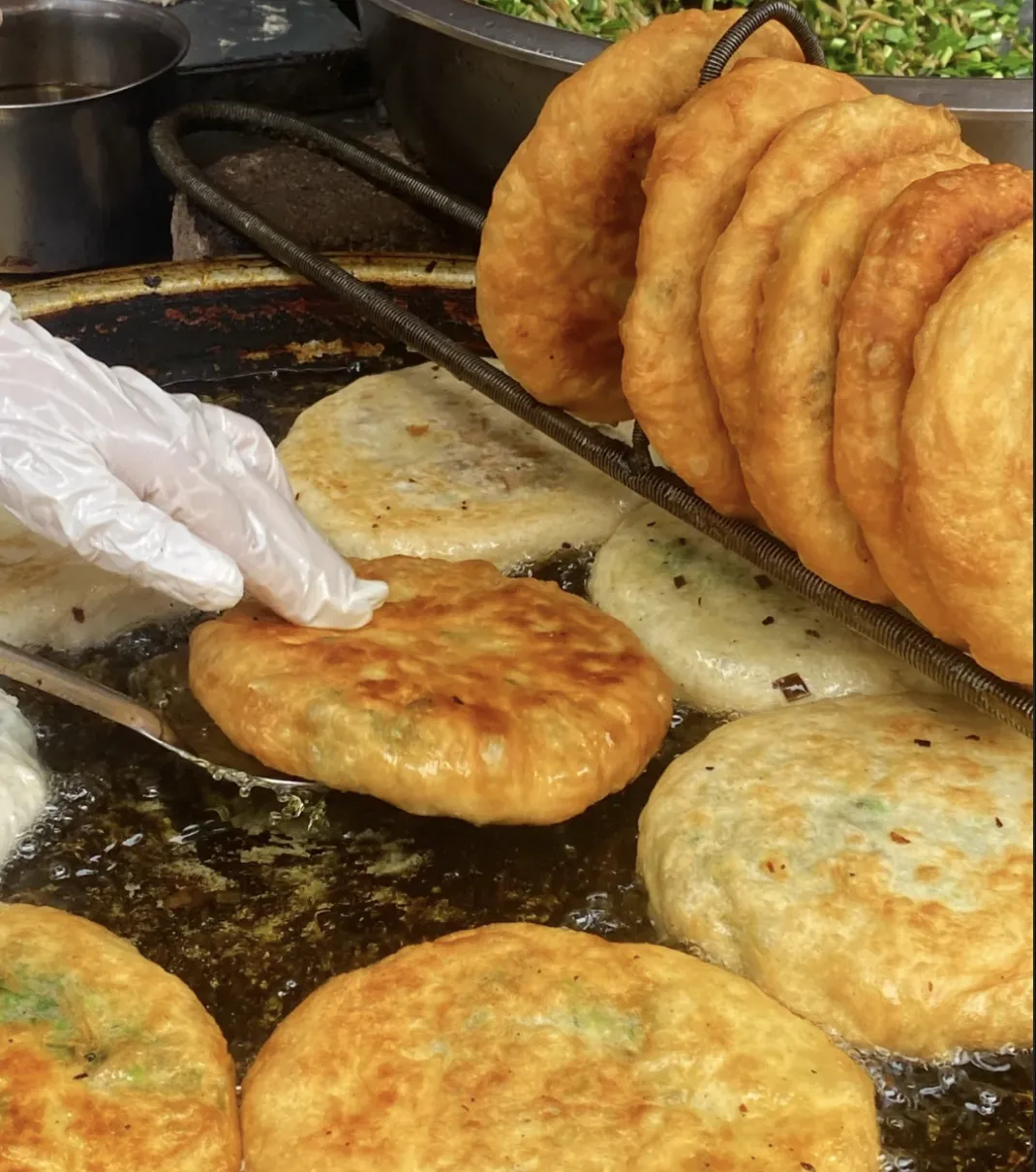
I found jiucai hezi on my fourth morning in Xi’an, by pure accident. I had been walking toward Sajinqiao, chasing a rumored bowl of soup, when a side lane stopped me cold. A griddle wide as a table sat at its mouth, and on it lay a neat row of golden half-moons, sizzling and blistering in the oil. The smell hit me before I understood what I was looking at: green, sharp, almost oniony, with a buttery note underneath — chives waking up to heat. An old woman flipped one over with a spatula, and the crust crackled like breaking ice. I pointed at the griddle. “Two,” I said.
What Exactly Is Jiucai Hezi?
Jiucai hezi (韭菜盒子) is a half-moon pastry: a sheet of wheat dough stuffed with chopped chives, scrambled egg and soft, thin vermicelli, crimped shut along the edge and pan-fried in oil until the shell turns deep gold. The name is a small confession — jiucai means “chives” and hezi means “box”, which is exactly what it is: a sealed little package built to hold heat and fragrance.
Everything good about it comes from the contrast. The crust shatters when you bite it, crisp and flaky and faintly oily in the best way. Inside, the filling is almost violently hot: fresh chives that turn sweet as they cook, egg that soaks up the oil, vermicelli that gives the whole thing a soft, chewy body. It is meat-free, cheap and shockingly satisfying — a proper breakfast disguised as a snack.
Why Xi’an Does It Better
Stuffed, pan-fried pastries — the family northerners simply call hezi — are an institution across the northern half of China. For centuries wheat, not rice, has been the backbone of cooking here, a habit the old Silk Road trade routes helped cement; bread and dough are the daily language of these streets. What makes Xi’an’s version special is not the formula but the timing. Hezi is a morning food here, sold from sunrise at stalls that fire up their griddles before the city wakes. And it lives or dies on one ingredient: fresh chives.
Xi’an cooks treat chives like a season, not a garnish. The first chives of spring — thin, mild, sweet — are prized enough that breakfast lines grow noticeably longer around Qingming. By lunchtime the smell has already faded from the streets, which tells you everything: this is a dish that refuses to wait.
My First Bite
The box came wrapped in a square of brown paper, too hot to hold comfortably. I stood at the mouth of the lane, took a breath and bit in. The shell gave with a crack that made the stall owner smile. Inside, the filling was volcanic — chives and egg in a steamy tangle, the greens sweet and pungent, the vermicelli slippery and soft. My first bite was too fast and I burned my tongue, but I barely noticed. The second bite, properly cooled, was the one I remember: standing in the morning air with a hot pastry in one hand and a cup of sweet soy milk in the other, I finally understood why locals eat this standing up, in a hurry, before the day begins.
Where to Eat It in Xi’an
The best jiucai hezi comes from the breakfast stalls tucked into residential neighborhoods — the lane-side carts tourists rarely notice — and from the small shops around the Muslim Quarter: the lanes off Beiyuanmen, Dapiyuan, and the stretch around Sajinqiao. Prices are almost laughably uniform at 3 to 6 yuan each, so the difference comes down to fire and freshness. My rule is simple: find the stall where the griddle never stops moving and a queue of locals has already formed. The golden window is seven to eight in the morning, when the first batches come off the iron; after nine, you are mostly choosing among pastries that have gone soft.
Famous Shops & Century-Old Names
Most mornings I get my jiucai hezi from a lane-side cart, but when I want the version that has been made the same way for generations, I go looking for the old names. Two of Xi’an’s time-honored restaurants keep chive boxes on the menu, and for the street version, one rule has never failed me.
Xi’an Fanzhuang (西安飯庄)
Founded in 1929, Xi’an Fanzhuang is a China Time-Honored Brand (中华老字号) and one of the city’s grand old Shaanxi restaurants, standing near the Bell Tower on East Avenue. The kitchen does traditional noodles and home-style dishes properly, and the jiucai hezi here is a steady, polished way to taste the old Xi’an version when you want to sit down to it.
De Fa Chang (德發長)
Another China Time-Honored Brand, De Fa Chang opened in 1936 near the Bell Tower and is famous for its dumpling banquet. It keeps chive boxes on the menu alongside the dumplings, which makes it a convenient stop when you want the classic pastry served hot without hunting down a street stall.
Street Breakfast Stalls (街頭早餐攤)
Deep down, jiucai hezi is street breakfast, and no plaque beats a hot griddle. Follow the stalls tucked into residential neighborhoods and the lanes of the Muslim Quarter, and pick the one with a queue of locals and a spatula that never stops moving — that is where I would send you first.
Tips for First-Timers
Eat it straight off the griddle. A chive box starts losing its magic the second it leaves the heat — the crust softens and the chives turn dull. Wait for a fresh one.
Cool the filling before you commit. The inside is far hotter than the shell. Bite gently, let the steam out, then go in properly.
Pair it with soy milk or congee. The classic morning combo — the sweet, mellow drink balances the sharp green chives perfectly.
It is genuinely vegetarian. No meat, no stock. In a city where meat usually rules the menu, this is a dependable meat-free breakfast.
Do not over-order. They reheat poorly. Buy two, eat them hot, and go back for more if you are still hungry.
My Verdict
Jiucai hezi is not the most famous thing Xi’an has to offer — most visitors arrive knowing about roujiamo and paomo, not this humble half-moon. But it is the dish I kept coming back to. A few yuan buys you a golden crescent stuffed with the smell of spring and a morning exactly like the one every local around you is having. Just do not settle for the tourist breakfast spots on the main drag. Walk one lane deeper, and the sound of the griddle will lead you to a better one.