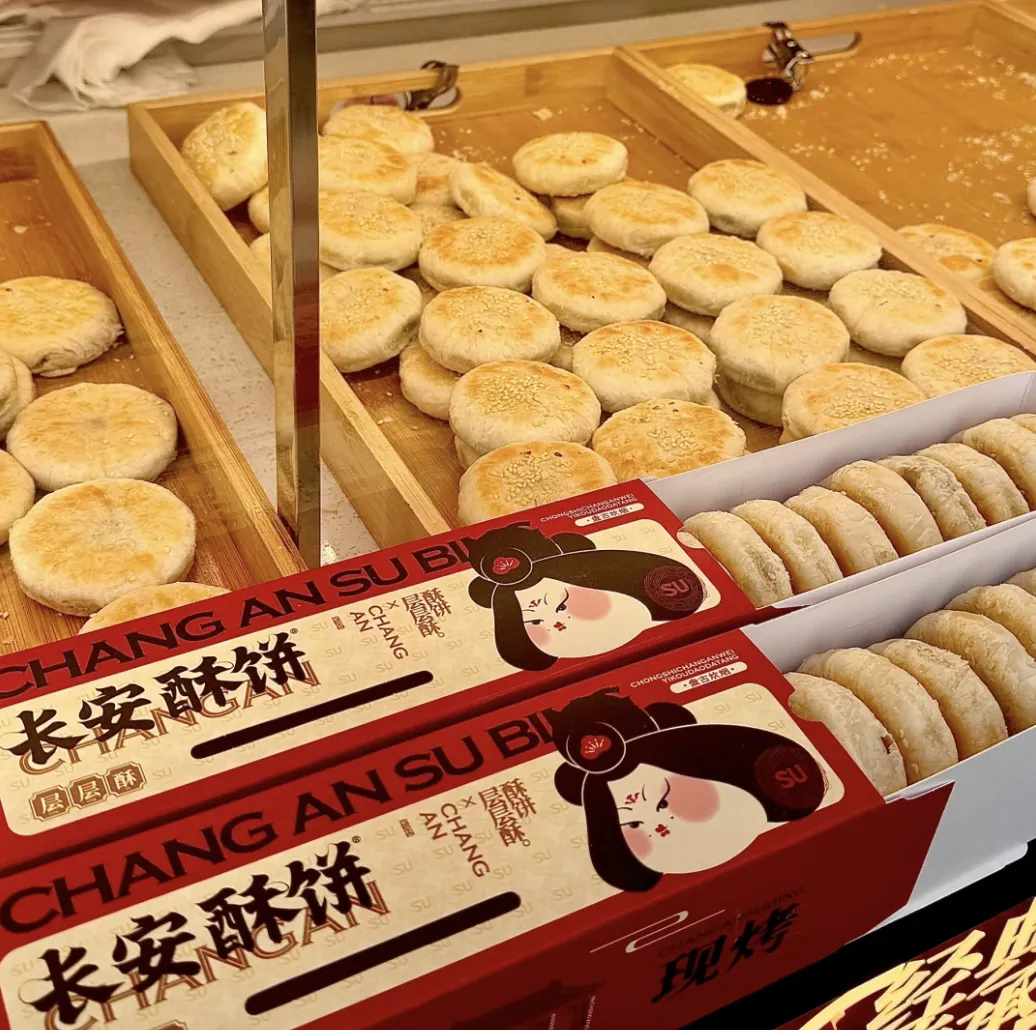
I found Qin Su by accident, which is how the best things in Xi’an usually find you. It was a cool October evening, and I had wandered out of the Muslim Quarter with no plan beyond “find something sweet.” A small pastry shop near the Bell Tower had a glass counter glowing under warm light, stacked with rows of golden pastries that looked like little towers waiting to shatter. The shopkeeper, a grandmother with flour on her sleeve, pushed one into my hand without being asked. It was still warm. I bit in, expecting an ordinary flaky pastry — and the crust came apart with a crisp pop, and the filling rushed over my tongue: rich red bean, deep jujube, toasted nuts. I stood in the doorway of that shop and ate three more before I could form a sentence.
What Exactly Is Qin Su?
Qin Su (秦酥) translates as “Qin crisp” — the Qin of the ancient state that once ruled these plains, and the su of flaky pastry. It is a traditional Shaanxi sweet: a thin, multi-layered shell so crisp it falls apart at the touch, wrapped around a dense filling of red bean paste, jujube (red date) paste and chopped nuts. Every bite arrives in two stages: first the loud, satisfying shatter of the crust, then the deep, earthy sweetness of the filling. It is not a subtle dessert. It is rich and nutty, built from nothing louder than good ingredients — and it is completely vegetarian, which matters more than you would think in a city whose menu is ruled by lamb.
The Name Is the History
Calling it “Qin” is no decoration. Qin was the state that conquered its rivals and unified China in 221 BC under the First Emperor, whose capital stood on these plains — and whose tomb, guarded by the Terracotta Army, lies just outside modern Xi’an. Shaanxi is the old Qin heartland, and the name is a deliberate, proud brand: this is the pastry of the land that gave the world the word China, which scholars trace back to Qin.
The fillings carry roots just as deep. Jujubes — red dates — have been grown in Shaanxi for millennia, and the sweet, faintly smoky depth of date paste runs through the region’s desserts. Paired with red bean, the other pillar of northern pastry, and toasted nuts, it is old-fashioned in the best way: nothing flashy, nothing modern, just three classic flavors stacked with the same patience as the crust’s layers. That is also why qin su has become one of Xi’an’s favorite gifts to carry home — it keeps well, travels well, and it tastes like the city itself.
My First Bite
That first bite outside the Bell Tower shop stays with me. The crust did not crack; it shattered, in the satisfying way that sends a few thin flakes onto your sleeve. The filling was dense and still warm, and for a second the red bean and jujube tasted almost savory, until the nuttiness of the filling arrived and pulled the whole thing back to sweet. It did not resemble any pastry I knew — neither the soft mooncake nor the stiff western biscuit, but something that treated crispness as the main event.
I went back the next morning to buy a box for home, and the grandmother wrapped each piece in a square of paper, paused, considered, then added one extra on top. “For the road,” she said — or that is what I assumed she said; I was too busy eating to ask. By the time I reached my hotel, the box was one short.
Where to Eat It in Xi’an
Qin su is a bakery-and-gift-shop food rather than a street-stall one. In the Muslim Quarter, the pastry counters along Beiyuanmen and the surrounding food streets stock it beside the city’s other famous sweets; further out, shops near the Bell Tower and on Shuyuanmen, the old book street, sell gift boxes that locals buy for visiting relatives, and old-established houses such as Demaogong (德懋恭) keep the city’s traditional sweets. The trick is to look for counters where the qin su is stacked openly instead of shrink-wrapped — that is the fresh batch. A box runs roughly 15–30 yuan, which makes it one of the cheapest good gifts in Xi’an.
My rule: buy a single piece first, eat it while it is still crisp, and only then commit to a box. In my experience the boxed ones from neighborhood shops are fresher and cheaper than the tourist versions near the main gates, and every shop I tried was happy to let me taste before I bought.
Famous Shops & Century-Old Names
If you want a box worth carrying home, these are the places I keep coming back to.
Muslim Quarter & Bell Tower souvenir shops (回民街/鐘樓伴手禮店)
Qin su is a young name in this city of old pastries — a gift brand that rose to popularity in recent years rather than a century-old house. Most brands keep their counters in the Muslim Quarter and around the Bell Tower, with a few out by the Tang Paradise, and nearly every one of them lets you taste before you buy. That is the part I always insist on: sample one piece while it is still crisp, and only then commit to the box.
De Maogong (德懋恭)
For the century-old side of the story, De Maogong is the name to know. Founded in 1872, it is one of the city’s certified time-honored houses — the kind that has outlived dynasties — and though its signature is the crystal cake, its counters also carry jujube and red-bean pastries very close in spirit to qin su. The wrapping keeps an old-fashioned formality about it, and when the gift needs to feel weightier than a souvenir, this is where I buy.
Tips for Ordering and Eating
Eat it fresh, and eat it soon. The whole point is the shatter; a box that sits in a suitcase for a week is a different, much sadder pastry. If you are flying home with it, buy it on your last day.
Treat it as a tea pastry. One piece with a pot of green or jasmine tea is the classic pairing — the tea cuts the richness and brings out the jujube.
Ask what is inside. Most shops sell a plain red-bean version and a nut one, and fillings vary from place to place; point and ask rather than assuming.
Vegetarians, relax. The traditional fillings are plant-based — red bean, jujube, nuts. If you are strictly vegan, it is still worth confirming the shop does not use lard in the crust.
My Verdict
Qin su will not change your life the way a first bowl of yangrou paomo might, but it does not need to. It is an honest, beautiful, inexpensive taste of old Xi’an — crisp, sweet, and quietly historical, the kind of thing you buy as a gift and end up keeping for yourself. At 15 to 30 yuan a box, it is the cheapest time travel the city sells. Buy two boxes. You will understand why after the first one.