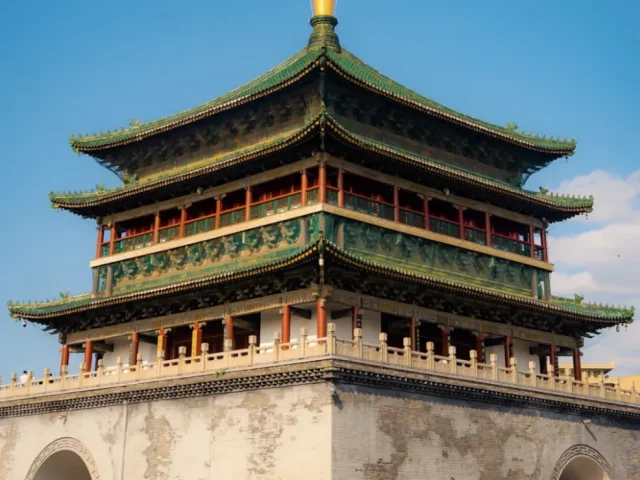
The first time I saw the Bell Tower, I wasn’t even trying to see it. I’d come up from the metro at the end of a long day of walking, and the escalator dropped me into the underground passage that circles beneath the tower. I followed the signs, surfaced through a stairwell into the dusk, and there it was: a three-tiered wooden tower on a square brick platform, its green glazed roof catching the last amber light, standing in the middle of a roaring roundabout like an island. Cars streamed past on both sides, and on the platform two photographers were crouched over tripods, waiting for the light trails to build up. I stood on the steps with my backpack for a good five minutes before I remembered I was supposed to be going somewhere.
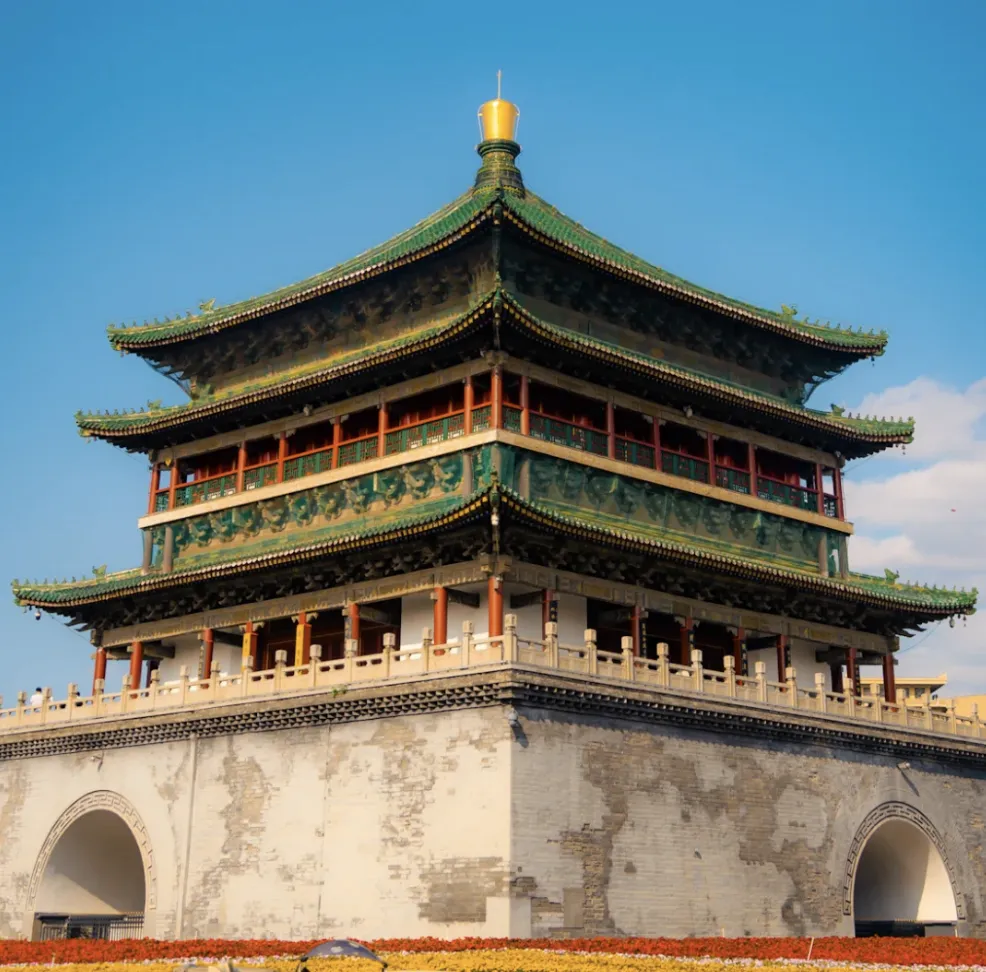
Xi’an Bell Tower at a Glance
- Built: 1384 (the 17th year of the Hongwu reign, Ming Dynasty)
- Location: the exact centre of Xi’an’s old city, where the East, West, South and North avenues meet
- Height: about 36 metres in total, three tiers, crowned with green glazed tiles
- Role: the “morning bell” of the old city – paired with the Drum Tower’s evening drum in the Ming/Qing time-keeping system
- Ticket: about 30 RMB (a combined ticket with the Drum Tower is about 50 RMB – verify current prices)
- Hours: roughly 8:30-21:00 in summer (shorter in winter; check before you go)
- Metro: Lines 2 and 4, Bell Tower station – the underpass leads straight to the ticket office
- Recommended time: 45-90 minutes for the tower itself; allow a half-day with the Drum Tower and Muslim Quarter
Why the Bell Tower Matters: A City That Ran on Sound
Few cities can be said to have run on a bell. Xi’an could. When the tower was completed in 1384, in the 17th year of the Hongwu reign, most of the population could not afford a clock – and, honestly, most did not need one. The day had a sound. At dawn the great bell boomed across the rooftops and the city gates swung open; farmers carried their vegetables to market and shops lifted their shutters. At dusk the drum to the west answered, and the gates closed for the night. Morning bell, evening drum – that rhythm governed daily life in Ming and Qing Xi’an, and the Bell Tower was the instrument that set the day in motion.
Here is the part I find remarkable. For its first two centuries, the tower did not stand where you will see it today. It was built a little to the west, on a busy crossroads closer to the Drum Tower. In 1582, during the Wanli reign, officials decided the tower belonged at the city’s true centre – the point where the four great avenues of the old city cross – and ordered it moved. Rather than dismantle the building, they relocated the entire wooden structure as one piece, sliding it across the ground on rollers and track with a team of labourers. The move was written down and celebrated, and it remains one of the most famous feats in the history of Chinese building. Stand under the eaves today and you are looking at carpentry assembled in the 1380s – carpentry that travelled, intact, two hundred years later.
The architecture deserves a slow look before you climb. The Bell Tower is one of the largest and best-preserved Ming-dynasty timber towers in China: three tiers of rooftops rising from a square brick platform, each eave supported by the interlocking wooden brackets – dougong – that let traditional Chinese roofs flex in the wind without a single nail in the load-bearing frame. The roof is dressed in green glazed tiles that glow almost like moss in the late afternoon, an unusual colour scheme that sets the tower apart from nearly everything around it. In total it rises about 36 metres, which on the flat, low-rise streets of the Ming city must have made it visible from every corner of the walled enclosure.
The bell itself has its own journey. The great bronze bell that once hung here – the Jingyun Bell, cast in 711 during the Tang Dynasty, centuries before the tower was even conceived – is no longer in the building. It now lives in the Forest of Stone Steles Museum, and the bell you can walk up to inside the tower is a faithful replica. I checked the label twice before I believed it. Standing beside the bell, with the whole old city spread out below, it is not hard to imagine the original note rolling out over the rooftops every morning for hundreds of years.
Climbing the Heart of the City: My Visit
The visit is compact – this is a tower, not a palace complex – and a brisk visitor can be up and down in under an hour. I took longer. The ticket office sits in the underground passage that runs beneath the whole roundabout, and the climb begins with a short flight of stone steps onto the platform. Inside, the air is cool and dim after the glare of the streets. The floors hold a small exhibition on the bell-and-drum system: old photographs from the early 20th century, when the avenues below were still rutted dirt roads and the tower stood almost alone against the sky; scale models of the Ming-era crossing; diagrams of how the time-keeping worked. The wooden stairs are steep, and the middle of each tread is worn smooth – you can see where a million footsteps have landed.
The top floor is where the tower earns its keep. Three doors open to the four points of the compass, and each frame holds a different avenue running dead straight to the horizon. East Avenue. West Avenue. South Avenue. North Avenue. Those are genuinely their names – the old city’s main streets are named simply by direction because they all begin here. Below, the traffic swirls around the brick platform in one great unending circle; from up high it looks like the city’s blood circulating. To the west the Drum Tower sits on its own platform, dark and solid, and beyond it the low roofs of the Muslim Quarter stretch away until they meet the high-rise horizon.
I arrived at golden hour and stayed until the lamps came on. One by one the streetlights down the avenues began to glow, and the tower’s own lights washed the green tiles in warm gold. A couple in wedding-style clothes posed against the railing; two teenagers sprawled on the platform steps below, sharing a drink. Standing at the exact centre of Xi’an – the geometric centre of the walled city, the point from which every old street radiates – I finally understood the phrase I’d seen in a dozen guides: the city’s heart. Not as a slogan. As a physical fact.
Inside the Bell Tower: What’s Where
The tower breaks into five practical parts, and knowing which is which saves you time.
- The tower itself: three floors of exhibition space, the replica Jingyun Bell, and the rooftop terrace with the four-avenue view. Stairs only – there is no lift.
- The brick platform and its arches: the square base is close to nine metres of solid brick, and four arched openings pass straight through it. In the old days the main streets literally ran beneath the tower; carts, sedan chairs and foot traffic all crossed through its shadow. The arches are sealed now, but you can still stand inside them and imagine the noise.
- The underground passage: where you buy your ticket, find the metro, and cross from one side of the roundabout to the other. It is cool in summer, busy at weekends, and lined with small shops. The signage to the tower ticket office is clear; the signage to your particular exit is not – orient yourself before you surface.
- The plaza and the ring road: at ground level the tower sits on a broad pedestrian plaza inside the traffic circle, with benches, evening strollers and the constant ring of traffic all around.
- The four avenues: each has a character. East Avenue is lined with department stores and leads to the Kaiyuan Mall skybridge (useful for photos); West Avenue heads to the Drum Tower and the Muslim Quarter; South Avenue runs all the way to the City Wall’s South Gate; North Avenue disappears into older residential blocks.
Practical Guide: Tickets, Hours & Getting There
Tickets: about 30 RMB for the tower; the combined ticket with the Drum Tower runs about 50 RMB and is the smarter buy if you plan to visit both (you should). Students and seniors often get discounts, so carry ID. Prices do change – check the official channels before you go.
Hours: roughly 8:30-21:00 in summer, with last entry before closing; winter hours are shorter. The plaza, the streets and the night views are free and stay open as long as you want them.
Getting there: Metro Lines 2 and 4 to Bell Tower station drop you directly into the underground passage, from which the ticket office is a two-minute walk. A taxi from elsewhere in the old city is cheap and fast; from the City Wall’s South Gate it is a single metro stop. For the wider logistics of the old city – transport, SIM cards and the rest – see our Xi’an travel tips.
Getting up: stairs only, no lift. Keep your bags light and wear shoes that grip – the wooden treads are smooth with age.
Best Time to Visit
The honest answer is dusk. About forty minutes before sunset the light turns warm on the green tiles, and for the next hour and a half the tower goes through its best performance: amber glow, then the blue of early evening, then the floodlights washing it in gold while the traffic paints light trails around the base. If you want to be up top for the transition, time your climb for about an hour before sunset.
For a daytime visit, the morning is best – cooler, quieter, and the light is clean for looking down the avenues. Seasonally, spring (April-May) and autumn (September-October) give the most comfortable air and the clearest views; summer afternoons are brutally hot on the open platform, which has no shade at all, so go after 17:00; winter is cold up top, but the crowds thin out and the tower over a dusting of snow is a quiet classic. Note that the tower itself closes around 21:00 – for after-dark photography at ground level, the plaza never shuts.
Photography Spots
- The classic night shot: from the underground passage exit at the edge of the roundabout, low angle, tower floodlit, cars streaking past – a long exposure if you have a tripod.
- Kaiyuan Mall skybridge (East Avenue): an elevated, head-on view down the avenue with the tower dead centre; at sunset or blue hour it is the best structured shot in the old city.
- From the East Avenue pavement, looking west: the tower framed by the avenue’s lamp posts, the green roof glowing against the dusk sky.
- From the top at golden hour: look west to the Drum Tower with the Bell Tower’s tiled eaves in the foreground – two Ming landmarks in one frame.
- The plaza at dusk: step back and include people, pigeons and the traffic circle for scale; this is the shot that shows the tower is a living crossing, not a museum.
Where to Eat Nearby
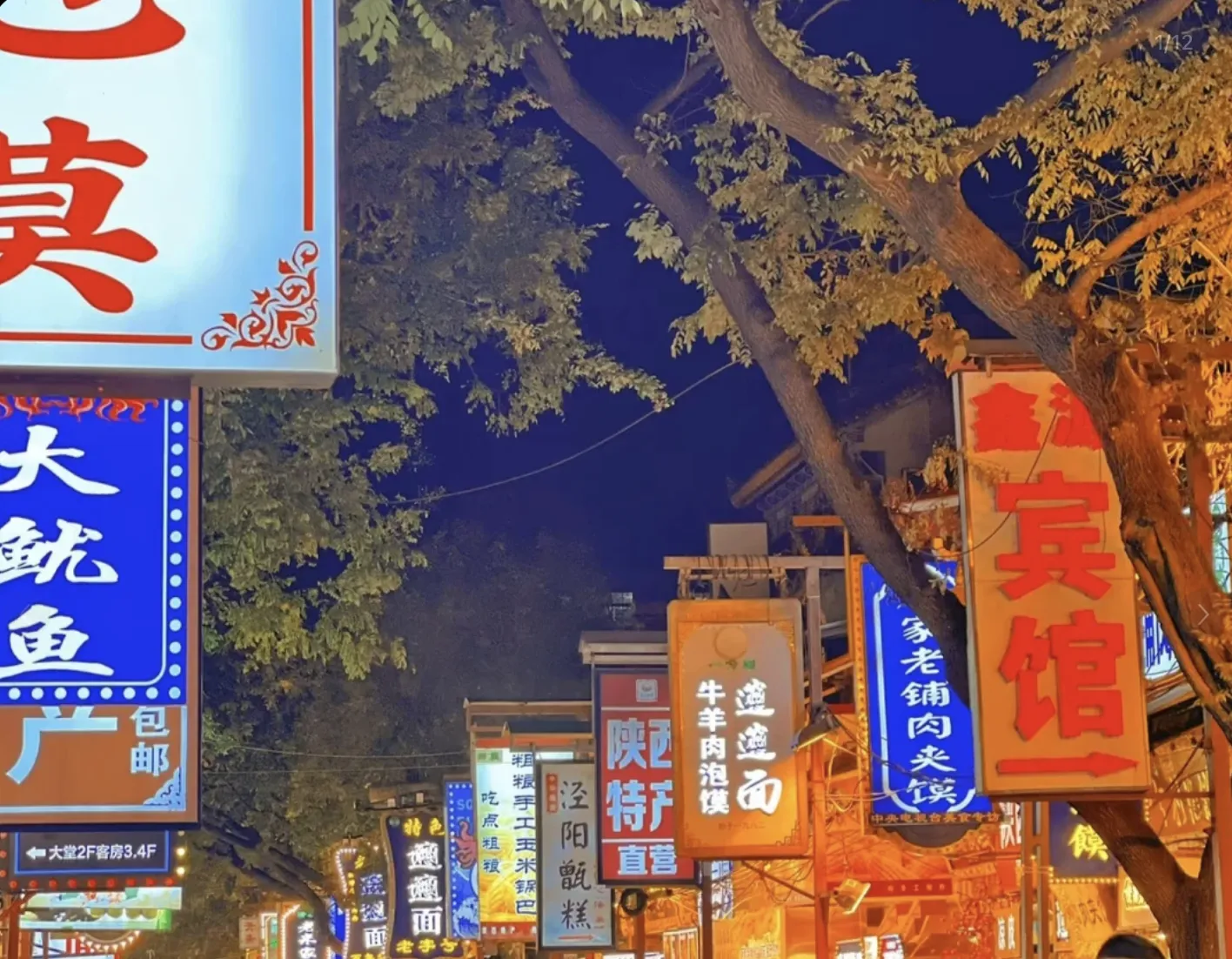
The immediate ring around the tower is touristy, and the snacks sold right at the plaza are overpriced and average. Do yourself a favour and walk. Five minutes west along West Avenue brings you to the Drum Tower, and directly beneath it begins the Muslim Quarter – Xi’an’s great food street, where the city’s Muslim community has been cooking for centuries. There you can work through the classics: roujiamo (the “Chinese hamburger”), a steaming bowl of yangrou paomo that you tear the bread into yourself, and lamb skewers grilled over coals that fill the street with smoke by evening. Five minutes in the other direction, East Avenue and the pedestrian street of Luomashi offer cheaper, quieter places that locals actually use.
For the full breakdown of what to order and where, see our Xi’an Food Guide.
How to Combine It With the Rest of Xi’an
The Bell Tower and the Drum Tower are a natural pair – literally a pair: two Ming towers about 200 metres apart, once connected by the rhythm of bell and drum, joined again today by a combined ticket. A classic old-city day goes like this: morning at the Bell Tower and Drum Tower, lunch in the Muslim Quarter, then one metro stop south to the City Wall’s South Gate for a sunset walk or a bike ride on the wall. Everything sits within a fifteen-minute radius – which is exactly why the tower occupies the centre of most Xi’an itineraries.
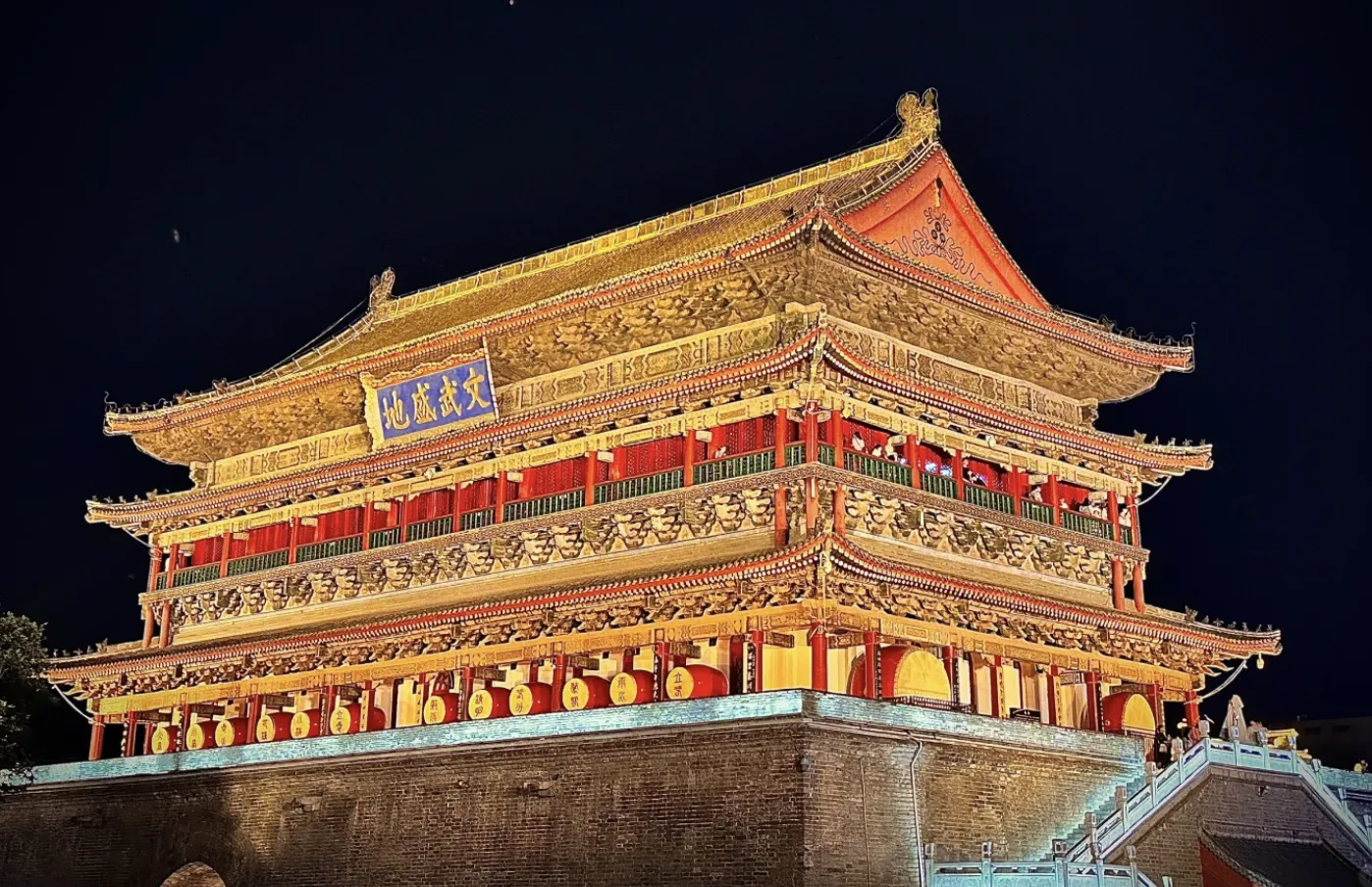
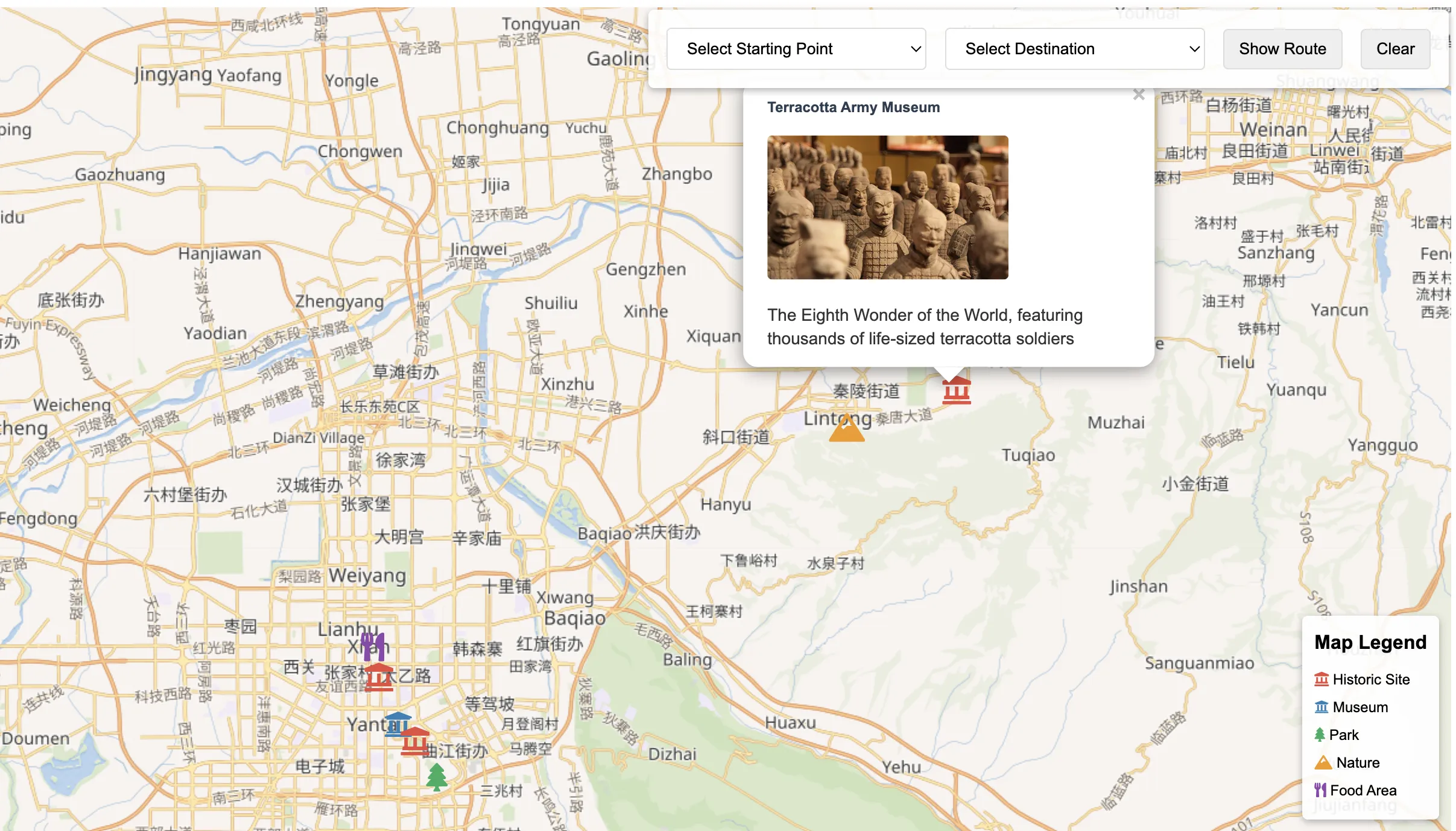
In the evening the order reverses beautifully: dinner in the Muslim Quarter, then a slow walk back past the lit Drum Tower to the Bell Tower for night photography. And if your schedule stretches beyond the old city, our day-trips guide covers the Terracotta Warriors and the wider region.
Common Mistakes to Avoid
- Paying full price twice: if you are visiting both towers (you are), the combined ticket costs about the same as the single one – buy it once.
- Climbing at noon in summer: the platform is an oven, there is no shade, and the view is hazy. Go in the evening.
- Surfacing from the wrong exit: the underpass has several exits; check the sign for the tower ticket office before you climb the stairs, or you will walk halfway around the roundabout for nothing.
- Eating at the plaza: the stalls right under the tower charge tourist prices. Walk five minutes to the Muslim Quarter or East Avenue.
- Expecting a bell ceremony: the bell inside is a display piece – a replica of the Tang original, which lives in the Forest of Stone Steles Museum. If you want a performance, the Drum Tower’s drum shows are the ones to catch.
Frequently Asked Questions
Is the combined Bell Tower / Drum Tower ticket worth it? Usually, yes: about 50 RMB combined versus roughly 30 RMB for the Bell Tower alone, and the two are a five-minute walk apart. Check the current official price, as it changes.
What time does the Bell Tower close? Around 21:00 in summer, with last entry before closing; winter hours are shorter. The surrounding plaza and streets stay open all evening.
Which metro exit is closest? Lines 2 and 4 both serve Bell Tower station, and the station connects directly to the underground passage leading to the ticket office – just follow the Bell Tower signs.
Can you go up? Yes. The interior is open, with exhibits on each floor, and the top floor looks out over the four avenues. It is a staircase climb – there is no lift.
How long should I allow? An hour covers the tower comfortably. With the Drum Tower, a Muslim Quarter lunch and a stroll down the avenues, plan on a half-day.
My Verdict
I stayed until the floodlights came on and the traffic thickened for the evening rush. On the way down the worn wooden stairs, I kept thinking about the morning bell – that for over five hundred years, the first sound of every Xi’an day came from exactly this spot, from a bronze voice rolling out over rooftops that have changed less than you would think. The Bell Tower is barely 640 years old, which in a city with three millennia of history makes it almost a newcomer. But it is the one place in Xi’an where you can stand at the exact centre of everything – the streets, the history, the noise – and feel the whole city beating at once.
Recommended Guides
- Xi’an Travel Guide Home — attractions, food, itineraries & insider tips
- Xi’an Attractions Guide — all must-see sights, tickets & hours
- Xi’an Food Guide — must-try dishes & top restaurants
Keep Reading
- Yangrou Paomo: Tearing Your Way Through Xi’an — Tearing Your Way Through Xi’an’s Iconic Lamb and Bread Soup