I still remember the afternoon I fell for liangpi. It was late July in Xi’an, the kind of heat that presses down on you the moment you step outside the city walls. I had spent the morning at the Terracotta Army and rolled back into the Muslim Quarter dehydrated and slightly grumpy. A tiny stall near the street entrance, steam curling from a cauldron behind the counter, waved me over. Five minutes later I was holding a bowl of cool, trembling rice noodles slicked with chili oil and vinegar – and the whole city suddenly made sense.
What Exactly Is Liangpi?
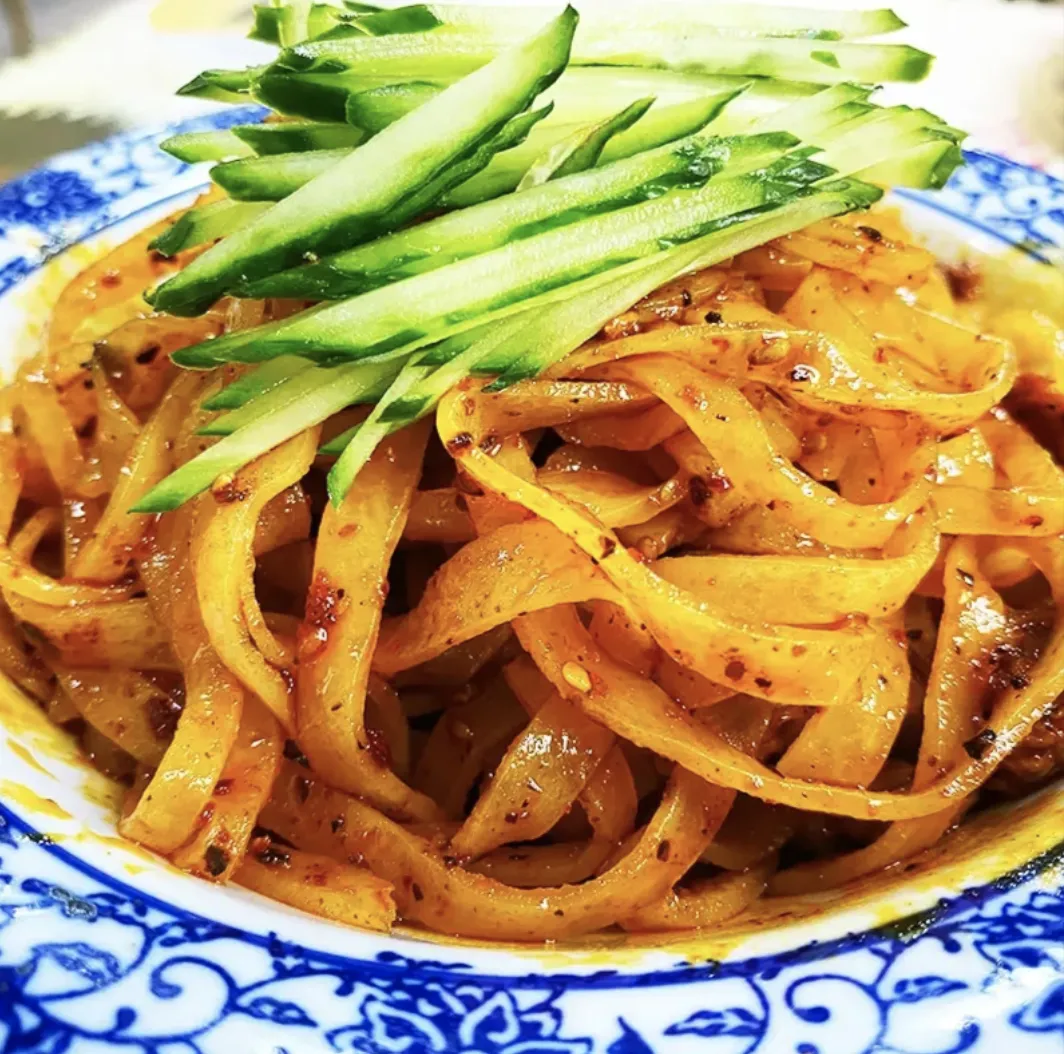
Liangpi (凉皮) translates roughly as “cold skin”, which tells you everything about the texture: thin, silky ribbons with a gentle, satisfying chew. The classic version is made from rice flour – a batter is steamed into thin sheets, then cut into ribbons and served cold. Each bowl is dressed with cucumber strips, bean sprouts, black vinegar, chili oil and crushed garlic, with a little sesame or peanut for depth. The result is sour, spicy, savoury and refreshing all at once.
Because it is served cold and built on rice rather than wheat, liangpi has become the unofficial summer dish of the Northwest – and, importantly, a genuinely excellent vegetarian option in a city where meat rules the menu.
Why Xi’an Does It Better
Shaanxi has been making cold noodles for centuries, and as the eastern terminus of the Silk Road, Xi’an absorbed culinary habits from Central Asia and the Middle East long before most of China did. That history shows up in the bold seasoning: the vinegar, the toasted chili, the garlic. Liangpi isn’t shy. It’s a dish that expects you to pay attention.
Locals will tell you the very best liangpi comes from Qinzhen, a town just outside Xi’an that claims to be the dish’s birthplace – and plenty of Xi’an shops advertise their Qinzhen heritage on their signs. But you don’t need to leave the city for a great bowl.
My First Bowl
The stall owner asked if I wanted it spicy. I said yes, not really knowing what I was agreeing to. She pulled a stack of cut noodles from the ice water, tossed them with cucumber and bean sprouts, then ladled on vinegar, a spoonful of chili oil and a fistful of crushed garlic. The first bite was cold, bouncy, and quietly electric – the chili arrived a second later, followed by the sharpness of vinegar and the bite of raw garlic. I ate it too fast, then ordered a second bowl with extra gluten (面筋), those spongy wheat bits that soak up every drop of sauce. That second bowl was the one I still think about.
Where to Eat It in Xi’an
Liangpi is everywhere, which makes it easy to find and hard to choose. My rule: follow the queue, then follow the garlic. In the Muslim Quarter you’ll find excellent bowls at the small food stalls around Beiyuanmen and the quieter side lanes – the ones tourists walk past without noticing. Outside the quarter, head for the small shopfronts near the city’s residential streets, where a bowl costs around 6-12 RMB and arrives in under two minutes.
If you want the sesame-paste variation, ask for mazhi liangpi (麻酱涼皮) – a richer, nuttier version dressed with sesame sauce that locals love in the cooler months.
Famous Shops & Century-Old Names
Here’s where I’d send you for a great bowl — the names locals trust, from a city-wide chain to the birthplace of the dish itself.
Wei Jia Liangpi (魏家涼皮)
Xi’an’s most widespread liangpi chain, founded in the 1990s and now a daily habit for locals. Their sesame-paste liangpi (麻醬涼皮) and the classic rice-paper version are both done properly. With branches all over the city — including near the Bell Tower and in Xiaozhai — you’re never far from a reliable bowl.
Qinzhen Lao Xue Jia (秦鎮老薛家米皮)
Qinzhen is the town that claims to be liangpi’s birthplace, and this family shop has been making rice noodles there for generations — a genuine century-old name. It sits in Huyi district, about 30 km outside the city centre, so it’s a pilgrimage for the truly devoted. Inside Xi’an, look for shops hanging the 秦鎮 mipi sign: plenty trace their recipe back to that town, and several of them are old hands themselves.
Hanzhong Re Mianpi (漢中熱麵皮)
Liangpi’s southern Shaanxi cousin. In Hanzhong-style shops around the city, the noodles are steamed fresh and served warm — 熱麵皮 literally means “hot noodles” — with a softer, more glutinous bite than the cold version. Several long-running shops in Xi’an serve it; one warm bowl shows you how the southern half of Shaanxi eats its liangpi.
Ordering Tips for First-Timers
Speak up about spice. “Weila” (微辣, mild) is a safe start; you can always add chili oil yourself from the jar on the table.
Add the gluten. A portion of 面筋 (mianjin) turns a good bowl into a great one – it soaks up the dressing like a sponge.
Go early or late. At lunchtime the popular stalls run out; the sweet spot is just before noon or mid-afternoon.
Watch the locals. If they’re getting it to go in plastic bags, you’re in the right place.
My Verdict
Liangpi is the dish I recommend to everyone visiting Xi’an – vegetarian or not. It’s cheap, fast, refreshing, and completely unlike the Chinese food most visitors know from back home. Five yuan for a bowl of history and ice-cold relief? That’s the deal of the trip.