I met qianceng on my third morning in Xi’an, and I have not quite recovered since. It was early October, the air sharp and cold in that pre-dawn way unique to cities that have just woken up. I was walking through the Muslim Quarter near Sajinqiao looking for breakfast when a stall up ahead made me stop. The baker was rolling a piece of dough impossibly thin, painting it with oil, then folding it over itself again and again until it became a fat, layered round. When she slid it onto the griddle, the oil hissed, and the smell of toasted wheat and sesame rolled down the street. I pointed at one, paid the equivalent of about a dollar, and took my first bite standing up, still blinking in the cold morning light. It shattered.
What Exactly Is Thousand-Layer Flaky Bread?
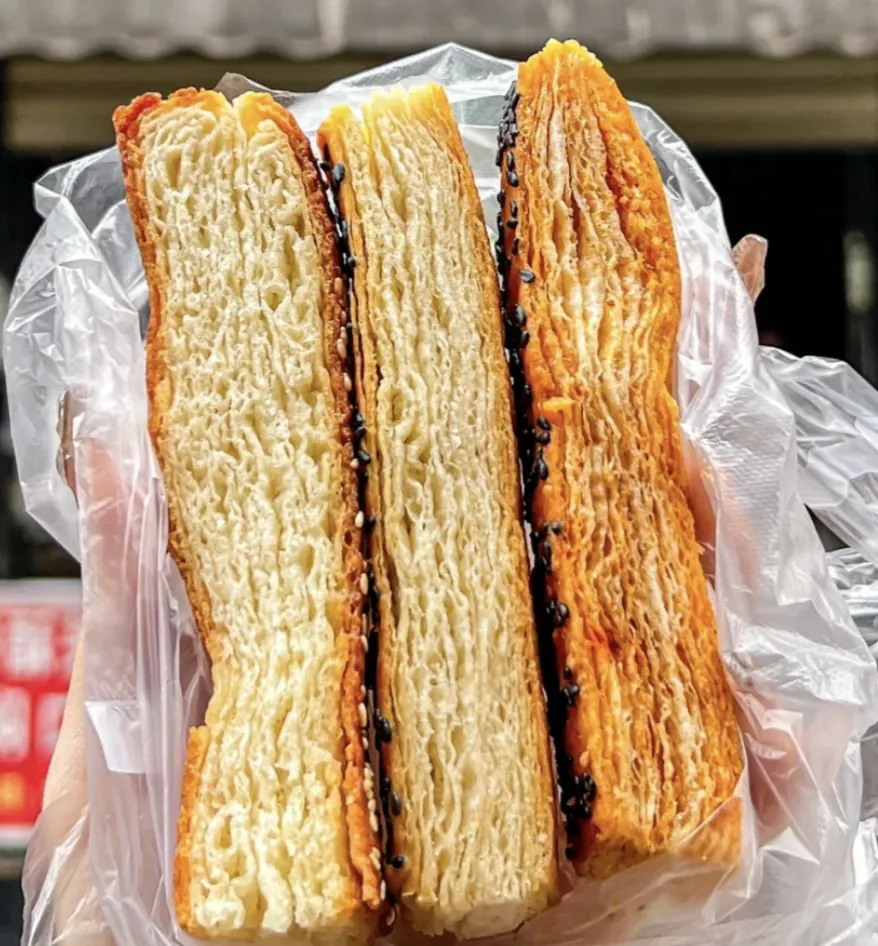
Qianceng (千層油酥餅) translates as “thousand-layer flaky bread”, and the name tells you where all the magic lives. A soft wheat dough is rolled thin, brushed with oil and seasoning, then folded over itself over and over; each fold becomes a papery layer, and when the round is finally baked and griddled until golden, the heat pushes every layer apart. The result is a compact disc of shattering crispness – you bite down and the crust splinters into a dozen thin leaves, each one warm, oil-fragrant and faintly toasty. There is no filling, and none is needed. Everything about the taste lives in the layers themselves.
It is savoury, subtle and completely vegetarian – just flour, oil, a little salt and, in the best versions, a generous coating of sesame.
The History Behind the Layers
Shaanxi has been wheat country for millennia, and the Wei River plain around Xi’an is among the finest wheat-growing land in China – which is why bread, not rice, anchors the local table. Layered pastries of this kind are part of the province’s everyday breakfast culture; the name qianceng, “a thousand layers”, is a proud exaggeration meaning simply “as many as you can fold”. Xi’an sits at the eastern end of the Silk Road, and its baking traditions absorbed Central Asian techniques over the centuries – the oil-and-fold method behind this pastry fits squarely into that long story of travellers, grain and griddles.
What makes it special is that it is not a special-occasion dish at all. It is breakfast, plain and unpretentious – the kind of thing a student grabs on the way to class or an office worker buys together with a carton of soy milk. Long history, zero ceremony.
My First Bite
The first thing I noticed was the sound. I bit into the golden disc and heard a clean, crisp crack, like breaking thin ice, before I felt anything at all. Then came the warmth – the pastry had left the griddle less than a minute earlier – and the layers, which peeled apart in my mouth like the pages of a warm book. Each thin leaf carried the faintest trace of oil and salt, and the toasted sesame on top gave everything a nutty finish that lingered long after I swallowed. I stood there in the street, jacket half unzipped, completely still, trying to understand how something so simple could taste like that. When I came back to myself, a ring of crumbs had gathered at my feet, and I walked straight back to the stall and bought two more – one for later, and one just in case.
Where to Eat It in Xi’an
Qianceng is a morning food, so look for breakfast stalls rather than tourist restaurants. In the Muslim Quarter, walk the lanes around Sajinqiao and the back streets off Beiyuanmen – that is where bakers set up in the early hours and sell straight off the griddle. You will find it too at small noodle-and-bread shops in residential neighbourhoods all over the city; the stalls near the eastern city wall around Dongxin Street are reliably good. Expect to pay 4-8 RMB a piece, and pick a stall where the baker is constantly shaping new dough – that turnover is your freshness guarantee.
Grab one with a cup of soy milk and you have the classic Xi’an breakfast combination.
Famous Shops & Century-Old Names
If you want the old names, the heart of it is still the Muslim Quarter. The noodle-and-bread stalls around Sajinqiao and Dapijuan have been baking layered pastries for generations – they still roll, oil and fold each piece by hand in front of you, morning after morning. Find the stall where the baker never stops shaping new dough, and the qianceng will come off the griddle with dozens of crisp, papery layers.
Muslim Quarter noodle-and-bread stalls (回民街麵食攤)
Around Huimin Jie, Sajinqiao and Dapijuan, these stalls are the most everyday home of the dish – pastry makers whose craft has been passed down through the generations of the Muslim Quarter, griddling each piece to order at dawn. The layers come out shatteringly crisp, and the sesame-dusted crust is exactly what I have been describing. Qianceng is breakfast and daily snack at once, and the stalls where locals queue are the ones to trust.
Xi’an Fanzhuang (西安飯庄)
Founded in 1929, this old Shaanxi restaurant near the Bell Tower on East Street is the place I would send you for the sit-down version. The kitchen does its pastries properly – the qianceng arrives hot with clean, separate layers – and pairing it with a bowl of hulatang or congee is the classic local way to eat it.
Ordering Tips for First-Timers
Eat it hot. The crispness is the entire point, and it fades fast. Eat it within minutes of it leaving the griddle; if it has been sitting under a warmer, ask for a fresh one.
Pair it with soy milk. A warm, lightly sweet cup of doujiang is the classic companion – it cuts the oil and makes the sesame taste brighter.
Go for the sesame. The rich, toasted sesame aroma is this pastry’s signature. A generous dusting of sesame seeds on the crust is the mark of a serious baker.
Check the layers. A well-made piece peels apart into visible papery leaves. If you cannot see layers, it is not the real thing.
Vegetarians, rejoice. Flour, oil and sesame only – one of the safest street-food bets in the city for anyone avoiding meat.
My Verdict
Qianceng is not the most famous thing in Xi’an, and that is exactly why I recommend it. It has no story to tell and no queue of tourists – just a baker, a griddle and a fold so old it feels like memory. It is cheap, fast and quietly perfect, and it is the breakfast I still think about whenever I remember that cold October morning. Find a stall before nine in the morning, order one, and eat it standing up. You will understand.