Dusk was falling over the Yan River when I finally stood on top of Baota Mountain, and the city below lit up in stages. First the pagoda at my shoulder flickered on, a warm amber glow spilling through nine storeys of ancient brickwork; then the bridges across the river began to shimmer; and finally the long ribbons of neon along the north bank switched on one by one. A gust of dry loess wind hit my face, carrying dust and the faint smell of smoke from a hundred courtyards. I had seen this skyline a hundred times in photographs and history textbooks, and it took that wind in my face to remind me that Yan’an is not a monument — it is a real city, lived in by real people, on a real river.
Yan’an at a Glance (2026)
- Location: about 300 km north of Xi’an on the Loess Plateau in northern Shaanxi
- Significance: seat of the CPC Central Committee from 1935 to 1948
- Getting there: high-speed rail about 2 hours, or long-distance bus about 4 hours (confirm the latest schedules)
- Tickets: most revolutionary sites are free or low-cost; Baota Mountain and Hukou Waterfall charge entry (official prices may change)
- Best season: April–June and September–October
- Recommended time: 2 days including round-trip travel; add a third day for Hukou Waterfall
Why Yan’an Matters
For thirteen years, from 1935 to 1948, this small valley city on the northern Shaanxi plateau was the base of the Chinese Communist Party’s Central Committee. After the Long March, the leadership made the region its home, and from the cave dwellings of Yan’an it directed the war against Japan and, later, the civil war that ended in the founding of the People’s Republic. Japanese air raids in the late 1930s drove many offices and homes literally into the loess hillsides — which is why so much of the city’s revolutionary heritage consists of caves rather than grand buildings. By the time the leadership moved on in 1948, the city had spent more than a decade as the political heart of the country, and the name Yan’an had become a symbol in its own right: self-reliance, austerity, and a rural base that outlasted every expectation.
For travelers, none of this is abstract. You can stand in the actual cave where Mao Zedong slept, walk into the plain brick auditorium where the Party’s Seventh National Congress convened in 1945, and climb the very pagoda that once appeared on the old 1-yuan note and stares out of a million textbooks. Domestic visitors often treat the trip as a pilgrimage — “red tourism” brings school groups and study delegations here in steady waves. I went expecting plaques and slogans; I found instead a place where the past is physical: rough-hewn cave doorways, enamel cups on wooden desks, earthen courtyards swept clean. As a foreign visitor, I found it fascinating for a different reason: it is a rare, concrete window into the 20th-century history that shaped modern China, told through places rather than politics.
Getting There: High-Speed Rail or Bus from Xi’an
The journey from Xi’an is simple, and the fastest option keeps improving. High-speed trains from Xi’an North station reach Yan’an station in roughly 2 hours — the rail corridor is being upgraded, so check the current timetables before you book. The slower, cheaper alternative is a long-distance bus from Xi’an’s main bus stations, which winds north for about 4 hours through loess hills and tunnel after tunnel. If your time is short, take the train; if your budget is tight and your schedule forgiving, the bus is perfectly workable.
- Book rail tickets in advance on the official 12306 app or website — trains sell out fast around Chinese holidays.
- Depart from Xi’an North station and get off at Yan’an station, which sits close to the city center.
- Take a taxi or ride-hailing car to your hotel — Baota Mountain is only 15–20 minutes from the station.
- If you are adding Hukou Waterfall, set aside a separate day with a hired car or a small group tour, since the waterfall lies a 3–4 hour drive from the city.
Baota Mountain: The Landmark
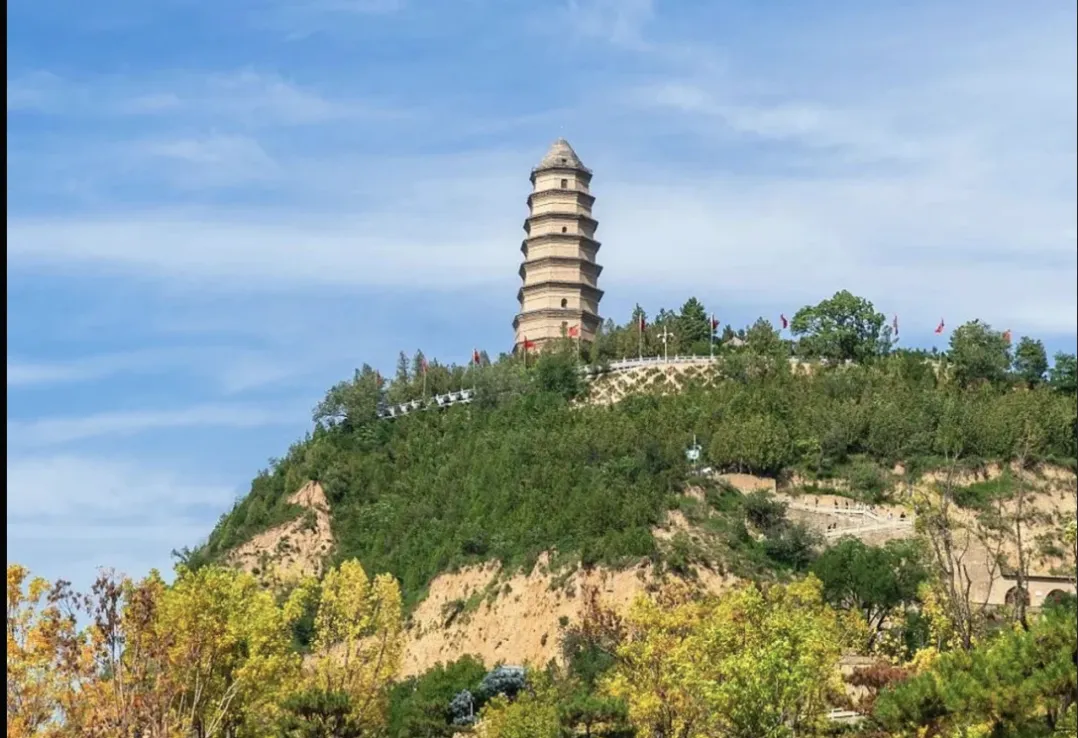
Baota Mountain rises straight off the eastern bank of the Yan River, and its nine-storey pagoda — roughly 44 meters of brick with Tang-dynasty origins rebuilt in later centuries — is the city’s defining image. The climb is a steady thirty to forty minutes up stone steps through pine and locust trees, and I recommend doing it twice: once in the long golden light of late afternoon, and once after dark, when the pagoda glows and the whole valley sparkles below. Admission is around 60 RMB (official prices may change), and from the summit you get the classic postcard view — Yan’an laid out along the river between bare, honey-colored hills.
Take water and a hat even in spring; the upper path has little shade, and the plateau sun is more intense than it feels. The mountain also gave me the moment that made the trip: standing above the city at dusk, watching the lights come on in neighborhoods whose names I had only ever seen in history books, I understood why a simple pagoda on a hill became the symbol of an entire era.
The Revolutionary Sites: Yangjialing, Zaoyuan & the Memorial Hall
Yangjialing was the nerve center of the base area, best known for its austere brick auditorium, where the Party’s Seventh National Congress met in 1945. Around it sit the cave residences of Mao and other leaders, furnished much as they were left — wooden desks, enamel mugs, the heated brick bed called a kang. The whole site is flat and easy to walk, remarkably free of commercial clutter, and quiet enough that you can stand in the doorway of a cave and simply imagine.
Zaoyuan means “jujube garden”, and this park-like complex was home to the leadership in the final Yan’an years. Mao, Zhou Enlai and Zhu De each kept cave residences here, and it feels calmer and more intimate than Yangjialing, shaded by old jujube trees. The Yan’an Revolutionary Memorial Hall, a large modern museum usually free of charge (check the official policy), ties everything together with Long March maps, wartime documents, photographs and everyday objects. Visit it first for context, or last if you prefer your history outdoors.
Throughout, the real star is the architecture of the region itself: the cave dwelling, or yao dong, cut into the soft yellow loess. Cool in summer and surprisingly warm in winter, these simple rooms are why the wartime capital functioned at all. A handful of converted cave compounds now operate as guesthouses, which is the closest you can come to sleeping inside history.
My Two Days in Yan’an
I arrived on a late train and went straight up Baota Mountain for the dusk view — that opening scene, with the wind and the faint smell of coal smoke, is the image I keep returning to. Afterwards I wandered the market street along the river: dried red dates sold by the kilo, burlap bags of millet, trays of the Shaanbei potato dish called yangyu caca, and whole shopfronts of paper-cutting. I ate a bowl of millet porridge sweetened with dates — the same breakfast this city has eaten for generations — and found the air so dry that my lips were cracking by midnight.
The next morning I walked the courtyards of Yangjialing, sat a while in the cool shade of a restored cave, and watched a school group file through the congress auditorium in hushed rows. By early afternoon I was at Zaoyuan, where the jujube trees were heavy with fruit, and by evening I was back on the train with a bag of dried dates and a paper-cut rabbit. Two days is exactly enough for the core of Yan’an. I left feeling that I had touched a piece of history most people only read about — and that the city’s humble food deserves more attention than it gets (a full rundown is in our Xi’an food guide).
A Realistic 2-Day Itinerary
- Day 1: Arrive by late-morning train; drop your bags; walk the riverside; climb Baota Mountain in the late-afternoon light and stay for the illuminated night view.
- Day 2: Morning at Yangjialing (allow about 2 hours), then the Revolutionary Memorial Hall; afternoon at Zaoyuan; catch an evening train back to Xi’an.
- Optional Day 3: a full day for Hukou Waterfall with a hired car or small group, returning to Xi’an the same night.
- Pacing tip: the main sites are strung along the river valley, so group them by geography and use taxis or ride-hailing rather than walking between them.
Special Situations: Hukou Waterfall, Seasons & Traveling with Kids
Hukou Waterfall is the region’s great add-on — the most spectacular fall on the Yellow River, on the border between Shaanxi and Shanxi, about a 3–4 hour drive from Yan’an. The river narrows and plunges through a gorge with a drop of about 20 meters, and on any windy day you come back coated in fine yellow spray. It is most dramatic in spring, when melting ice produces a “peach-blossom flood” around April, and in autumn, when the river runs high and brown; in deep winter the falls freeze into pale, sculptural shapes. Entry is around 100 RMB plus a shuttle bus, all subject to official prices. Go with a car or a small group, and confirm which bank your transport serves — there are viewing platforms on both the Shaanxi and Shanxi sides. History buffs with extra time can also detour to Nanniwan, about an hour’s drive away, made famous by the wartime self-sufficiency campaign.
Seasons: the Loess Plateau is dry year-round, so pack moisturizer, lip balm and sunscreen even in spring. Summer heat is real, and the revolutionary sites are almost entirely open-air — bring hats and water. Winter is cold but clear and photogenic; early spring can bring dusty winds. Families: the sites are flat and gentle for children, though the history will resonate more with teenagers than toddlers — balance visits with the pagoda climb and, if time allows, the waterfall. Photographers: come for golden-hour light on the loess terraces and the illuminated pagoda after dark; inside the museum, keep the flash off.
A Note on Timeliness (2026)
This guide reflects conditions in 2026, but prices, opening hours, reservation rules and train schedules all change. The Xi’an–Yan’an rail corridor is still being upgraded, so journey times may improve — always confirm current timetables on 12306, and check each site’s official ticket policy, including whether free museums now require a booked slot in your name. Crowds peak around Chinese holidays, so book transport and accommodation early. For broader planning help, see our Xi’an travel tips and our full list of Xi’an attractions.
Frequently Asked Questions
How far is Yan’an from Xi’an, and how long does it take?
About 300 km by road. A long-distance bus takes roughly 4 hours; high-speed rail about 2 hours, though schedules vary — check the latest timetables.
What is the easiest way to get there?
Take the high-speed train from Xi’an North station to Yan’an station, then a short taxi ride to your hotel. Book tickets in advance on 12306, especially around holidays.
Does Baota Mountain charge admission?
Yes — expect to pay tens of RMB, with official prices changing from time to time. The pagoda is illuminated at night, and the view from below is free.
Can I combine Yan’an with Hukou Waterfall?
Yes, but it adds a full day: the waterfall is a 3–4 hour drive from the city, so plan it with a hired car or small group tour. Spring and autumn are the most dramatic times.
Is two days enough?
For the core — Baota Mountain, Yangjialing, Zaoyuan and the Memorial Hall — yes. Add a third day for Hukou Waterfall, or a fourth if you want a slow pace and a cave-dwelling stay.
My Verdict
Yan’an surprised me. I went expecting a museum-city of plaques and slogans; I found a living place where the history is real, tactile and quietly moving — caves you can touch, an auditorium you can walk through, a pagoda you can climb, a river that still runs through the middle of it all. It is not for travelers who need grand architecture or refined cuisine; it is for the curious, the history-minded, and anyone who wants to understand modern China a little better. Pair it with our other day trips from Xi’an, and give yourself the two days — the climb, the light, and that dry yellow wind are worth it.