The first thing you notice about the Small Wild Goose Pagoda is the quiet. I stepped out of Nanshaomen metro station on a Thursday morning, followed the map past a pocket park where a retiree was practising slow sword forms under the plane trees, and turned onto a leafy lane that dead-ends at the old south gate of the Jianfu Temple. No tour buses idling, no hawkers waving laminated menus—just a line of ancient scholar trees with bark like braided rope, and behind them the pagoda: slender, dark, and completely still, the way very old things are still. I had pencilled it in as a forty-minute warm-up before the Shaanxi History Museum. Four hours later I was still there, sitting on a bench with a cup of soymilk, and I had already rearranged the rest of my trip.
Small Wild Goose Pagoda at a Glance
- Built: Tang Dynasty, Jinglong era (707-709), inside the Jianfu Temple
- Height: about 43 metres across 15 storeys of dense-eaved brick
- Climbing: not allowed—here you admire the tower from the gardens, unlike at its big sister
- Setting: Jianfu Temple grounds and the Xi’an Museum, one free park complex
- Ticket: free, but reserve a slot in advance through the official WeChat mini-program
- Hours: roughly 9:00-17:00; closed Tuesdays (always confirm before visiting)
- Metro: Line 2, Nanshaomen station, 10-15 minute walk
- Recommended time: 2-3 hours at a relaxed pace, four if you love museums
The Twin That Time Almost Forgot
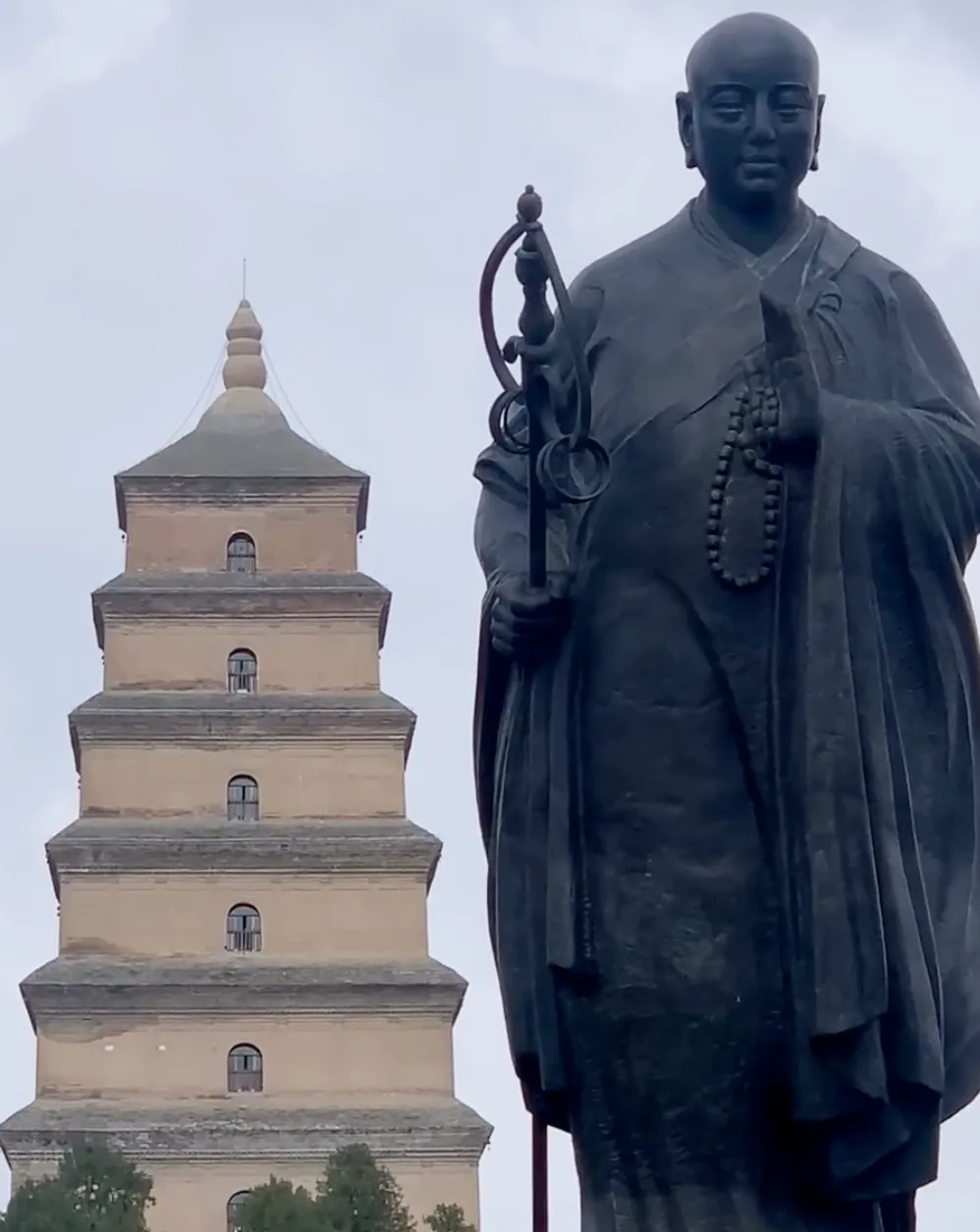
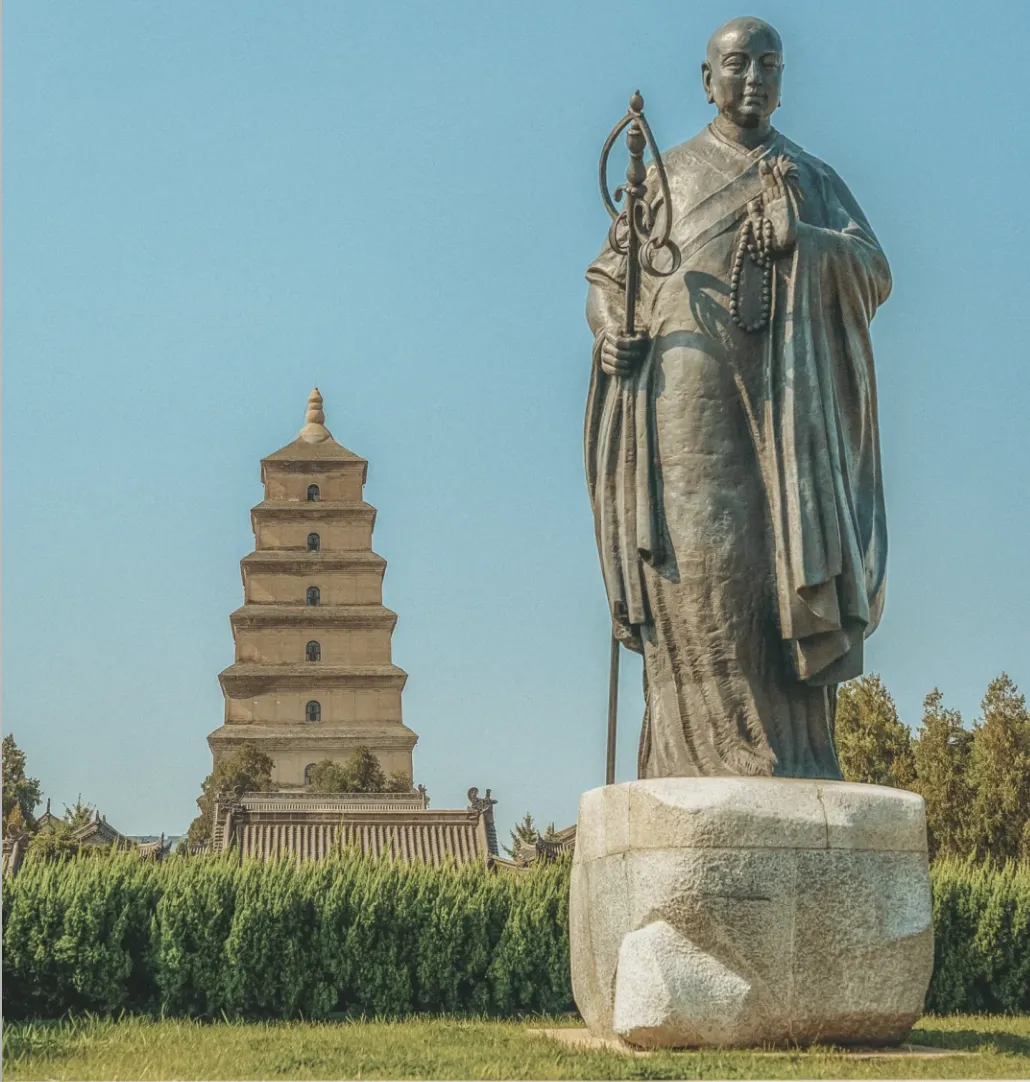
Every guidebook in Xi’an tells you about the Big Wild Goose Pagoda, the soaring brick tower that the monk Xuanzang built to hold the scriptures he carried home from India. Far fewer mention that Xuanzang had a quieter counterpart. A few kilometres to the southeast, on the grounds of the Jianfu Temple, the Small Wild Goose Pagoda was raised in the Jinglong era of the Tang Dynasty, between 707 and 709, for almost the same purpose: to shelter the Sanskrit manuscripts brought back by another travelling monk, Yijing, who had taken the sea route to India and returned with more than four hundred texts and a translator’s ambition to rival Xuanzang’s.
The temple around it tells its own story. The Jianfu Temple was founded in 684, at the request of the young Emperor Ruizong, to pray for the soul of his recently deceased father, Emperor Gaozong—”Jianfu” means to offer blessings for the departed. Under Empress Wu Zetian, whose reign filled the decades around the temple’s birth, it grew into one of the great monasteries of Chang’an, a capital that at its peak sheltered around a million people. Yijing set up his translation workshop here, and for the years of his slow, painstaking work the courtyard where I later sat with my soymilk was one of the intellectual centres of the medieval world.
What makes the tower extraordinary is how close it came to not existing at all. The pagoda has been cracked open by earthquakes more than once; records say the body split wide enough to see daylight through, and then, over the years, drew itself closed again—a phenomenon that fascinated local chroniclers and produced the tower’s famous legend of “three splits, three sealings.” The most destructive tremor of all, the great Huaxian earthquake of 1556, knocked the top off the tower, and the following centuries wore down whatever survived. Historians argue about the physics; locals just tell the story. Standing beneath a tower that the earth itself has torn apart and healed, you feel the depth of time more directly than any museum case can deliver.
Architecture explains part of the survival. The tower is a textbook example of the dense-eaved style: fifteen storeys of brick eaves stacked so tightly that the whole silhouette tapers like a folded umbrella. The tiered, self-buttressing profile is good at absorbing the shudder of earthquakes, which is part of why a building that has been split, shaken and damaged again and again is still standing after more than thirteen centuries. The interior, closed to visitors today, was once a hollow shaft with wooden floors and a staircase that let the faithful climb; the present brickwork seals that interior entirely out of sight, which only sharpens the mystery of what the old chroniclers described.
The pagoda has outlived almost everything around it. The temple that sheltered it fell into ruin and was rebuilt, reduced and rebuilt again; the tower stayed. In 1961 it was placed among the first batch of nationally protected cultural sites in China, and in 2014 it was inscribed as part of the Silk Road World Heritage listing that runs from Chang’an toward Central Asia. Today it sits inside the Xi’an Museum complex, and the pairing of ancient brick and modern architecture works better than it has any right to.
My Morning in the Quiet Court
With my reservation sorted on the phone the night before, I walked through the gate and immediately understood why locals treat this place as their backyard. The grounds are a proper city park as much as a heritage site: elderly men playing Chinese chess under the scholar trees, a grandmother walking her grandson by the pond, the click of mahjong tiles drifting from a pavilion. At nine in the morning on a weekday there were maybe thirty other visitors in the whole compound, and most of them were regulars.
Then you turn the corner and the pagoda is simply there, and it stops you. The dense-eaved silhouette makes it look far older than its big sister—more private, as if the tower had folded its arms. At about 43 metres it is roughly a third shorter than the Big Wild Goose Pagoda, and where that tower invites you to climb, this one politely declines; the pleasure is all in looking, and in walking slowly around it. I made three circuits before I noticed the bell.
The bell hangs in a small pavilion in the courtyard—a great iron casting from the Jin Dynasty, more than eight hundred years old, engraved all over with characters I couldn’t read but wished I could. Its morning toll was once so celebrated that it had a name of its own: “the Morning Bell of the Wild Goose Pagoda,” counted among the Eight Sights of Guanzhong that poets and painters of imperial China competed to capture. These days it rings, I was told, only on special occasions. I didn’t mind. Standing in the stillness, I decided the silence was the real attraction.
I saved the museum for the hottest part of the day, which turned out to be a wise move. Inside, the galleries are quieter still—the crowd that flocks to the Shaanxi History Museum never quite finds this place. The permanent exhibition “Ancient Capital Xi’an” walks you from prehistoric pottery through Western Zhou bronzes and Tang figurines to Ming porcelains. The object everyone gravitates to is a tri-colour glazed Tang horse frozen mid-gallop, front legs lifted, mane flying; it is the museum’s signature piece, and one glance explains why. I spent a long time with a Tang court lady figurine whose painted face had worn down to a ghost of a smile.
Walking the Grounds: What’s Where
The whole site—Jianfu Temple, pagoda, museum and gardens—forms one easy loop on flat ground, and it rewards a slow circuit. Roughly clockwise from the south gate, you’ll find:
- The Jianfu Temple courtyards: the restored halls (Mountain Gate, Great Hero Hall, the scripture tower) are modest and mostly quiet; the real treasures are the courtyard trees—scholar trees said to be more than a thousand years old, their trunks grey and knotted like old hands, and a towering ginkgo that turns the colour of honey in late autumn.
- The pagoda: the star of the show, best approached slowly from the west lawn. Take your time circling it; the brickwork, the small arched windows and the way the eaves throw sharp shadows at noon are all worth a slow look.
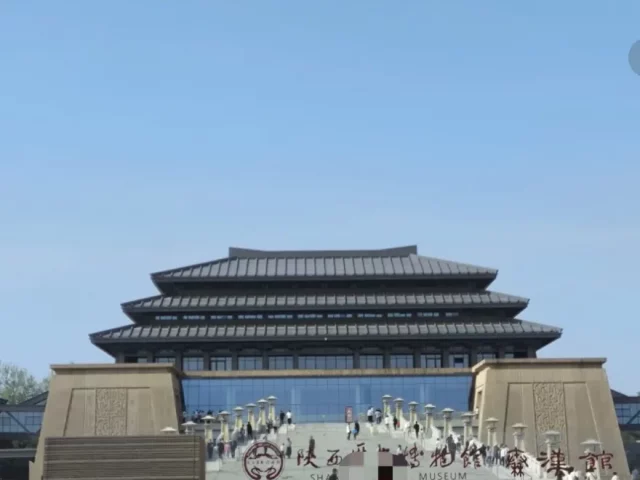
- The Xi’an Museum: the modern building at the southwest corner of the gardens is a piece of architecture in its own right, designed by Zhang Jinqiu, one of China’s most celebrated architects. Inside, the collection numbers more than 100,000 objects, and the permanent galleries reward a couple of unhurried hours.
- The gardens: lawns, a pond that holds the pagoda’s reflection, and benches under the trees. On sunny mornings the compound fills with tai chi groups and strollers; on rainy afternoons you may have the whole place to yourself.
Practical Guide: Tickets, Hours & Getting There
Reservation: the site is free, which is exactly why it needs planning. Book your slot in advance through the official Xi’an Museum WeChat mini-program (search “西安博物院”), registering with your passport or ID; slots typically open several days ahead and can run out on weekends and holidays. Bring the passport you registered with—the gate checks it. Don’t rely on walking in without a booking; on busy days the security desk simply turns people away.
Hours: roughly 9:00-17:00, with last entry about an hour before closing. The whole site is closed on Tuesdays, except during public-holiday weeks when the closed day usually shifts—check the announcement inside the mini-program.
Getting there: Metro Line 2 to Nanshaomen station, then a 10-15 minute walk south along the tree-lined street, following the signs to the Jianfu Temple. A taxi from the Bell Tower area takes about fifteen minutes. For more on getting around the city, see our Xi’an travel tips.
On site: everything sits at ground level—no steep climbs—so the site works fine with a pram and is easy for older travellers; the museum building has lifts. A couple of kiosks near the gate sell water and snacks, and a drink from the courtyard stall while you watch the pagoda is one of the great cheap pleasures of Xi’an.
Best Time to Visit
Go early on a weekday and you’ll have the pagoda almost to yourself. The site opens around 9:00, and that first hour is when the grounds belong to the tai chi crowd and the birds; the light is lovely for photographs. From about 11:00 the tour groups start to arrive, and on weekends the queue at the gate can stretch. For weather, spring (March-May) is the best compromise—the ginkgo and scholar trees leaf out in fresh green and the gardens are at their prettiest. Come late October or November and the ginkgo turns a staggering gold; the compound is arguably the most beautiful free thing in Xi’an at that time of year. Summer mornings are pleasant but afternoons are hot, with little shade along the main path. Winter is cold and quiet, but the bare trees give you clean sightlines to the tower and the crowds are minimal.
Photography Spots
- The west lawn, mid-morning: the classic angle—the full tower framed by the ginkgo, at its best when the leaves are gold in autumn.
- The pond reflection: on a still morning the pagoda doubles itself in the water; arrive before the breeze wakes up.
- Through the scholar trees: stand back on the south lawn and shoot the tower through the gnarled grey trunks for texture and depth.
- The museum atrium: the modern building is photogenic inside and out; catch its clean lines against the old brick tower in a single frame.
- Old and new: from the east lawn, line up the pagoda with the modern towers of the city behind it—the whole 1,300-year story in one shot.
Where to Eat Nearby
The Nanshaomen district and the streets south of the compound—Zhuque Avenue especially—are thick with small restaurants serving the classics done the local way: roujiamo (crisp pork-stuffed flatbread), yangrou paomo (lamb and torn bread simmered into broth), liangpi (cold rice noodles with chilli oil) and hand-pulled noodles. The Zhongmao Square mall right by the metro station has a whole floor of quick eats if you need something fast before heading to the museum. Our Xi’an Food Guide goes deeper into the city’s dishes, and if you’re new to them, read our pieces on roujiamo and yangrou paomo before you order.
How to Combine It With the Rest of Xi’an
The Small Wild Goose Pagoda sits on Metro Line 2, the same line that runs north through the Bell Tower and south toward the Shaanxi History Museum, so it slots neatly into a “south Xi’an” day. My own plan, which worked perfectly, was: morning here (free, calm, museums before the crowds), one stop south to the Shaanxi History Museum for the afternoon, then in the evening the Big Wild Goose Pagoda’s fountain show and the neon of Datang Everbright City—all without changing lines once. If you prefer the old-city loop, the Xi’an Attractions Guide will help you fit this quiet hour into the classic Bell Tower–Muslim Quarter–City Wall day, and our day trip ideas cover stretching farther afield.
Common Mistakes to Avoid
- Turning up without a reservation: free doesn’t mean walk-in. Book your slot days ahead, and remember the site is closed on Tuesdays.
- Confusing it with the Big Wild Goose Pagoda: different metro station (this one is Nanshaomen on Line 2; the Big one is Dayanta on Lines 3 and 4), different ticket model, different mood. Tell the taxi driver “小雁塔.”
- Expecting to climb it: you can’t—no climbing is allowed. The joy here is in looking, slowly.
- Rushing it: this is a two-hour minimum experience. Visitors who sprint around in forty minutes leave wondering what the fuss was about.
- Going mid-afternoon on weekends: the museum and gardens do get busy; the quiet you came for lives in the weekday mornings.
Frequently Asked Questions
Is it really free? How do I book? Yes, admission is free. Book a slot in advance through the official Xi’an Museum WeChat mini-program (search “西安博物院”), register with your passport, and show it at the gate. Slots fill up on weekends and holidays, so book a few days ahead.
What’s the difference between the Small and Big Wild Goose Pagodas? The Small one was built about half a century later (707-709) on the grounds of the Jianfu Temple to house the scriptures brought back by the monk Yijing, while the Big one is Xuanzang’s tower inside the Ci’en Temple. They’re about four kilometres apart with different metro stations: the Small one is free, quieter and closed on Tuesdays; the Big one charges admission and you can climb it.
Which day is it closed? Tuesdays, as a rule—though during public-holiday weeks the closed day is usually moved, so check the official announcement.
How long should I allow? Two to three hours covers the pagoda, gardens and museum at a relaxed pace; give it four if you read labels and linger.
Can I climb the pagoda? No—the interior is closed to visitors. The whole point is the view of it from the gardens, so bring the camera.
My Verdict
In a city that does spectacle as well as Xi’an does—fountains, armies of terracotta, neon avenues—the Small Wild Goose Pagoda is the counter-programme: a place that asks you to slow down instead of speeding up. It’s free, it’s beautiful, and it’s the rare Xi’an attraction where you can hear yourself think. If you have one quiet morning in your itinerary, spend it here. I did, and it ended up being the morning I replayed most often on the flight home.