It was the smell that got me first. On my first cold evening in Xi’an I was drifting through the Muslim Quarter with no plan except to eat everything in sight, when a stall up ahead pushed out a wave of steam that smelled like the entire spice market had been simmered into a single pot: cloves, star anise, bay leaves, and something warm and faintly sweet underneath. Behind the counter, a man in a flour-dusted apron lifted a flatbread from a little stone oven, split it with a knife, and swung a cleaver into a dark mound of glistening meat. The bread crackled as he packed in the filling and slid the sandwich across. I bit down, and my whole first week in Xi’an rearranged itself around that one moment.
What Exactly Is Roujiamo?
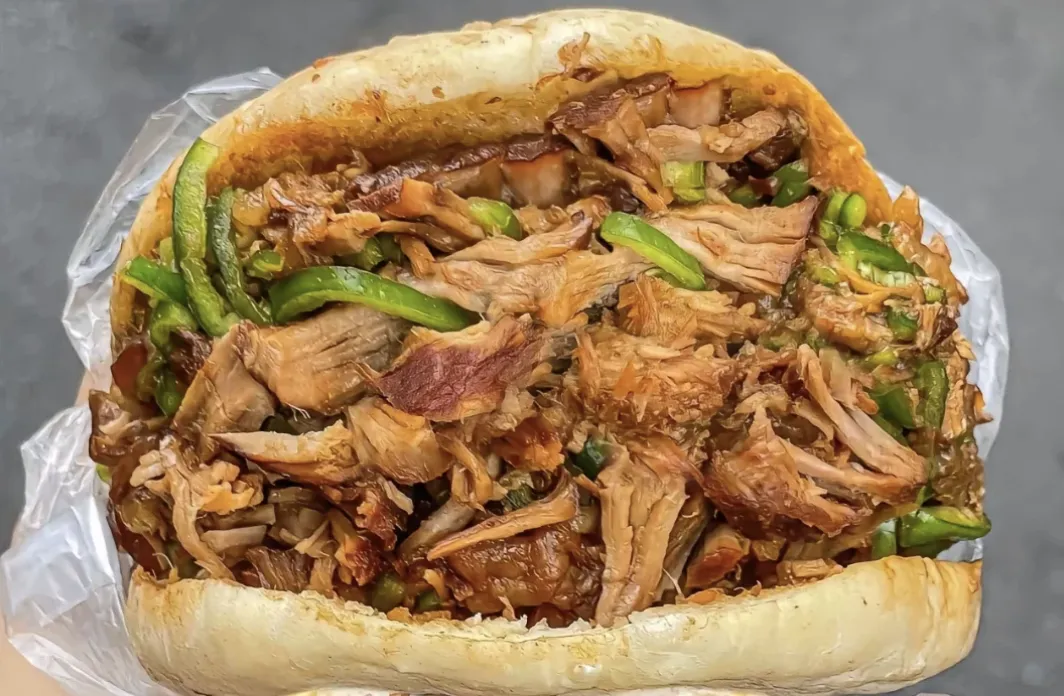
Roujiamo (肉夾饃) literally means “meat stuffed into a bun”, and English-language food writers have nicknamed it “the world’s oldest hamburger” – a title it wears with more honesty than most food marketing. The bun is a flat, round wheaten bread called baijimo, baked in a stone oven until the crust shatters and the crumb stays soft. The filling is pork – or beef, in the halal kitchens of the Muslim Quarter – braised for hours with more than twenty spices until a cleaver barely has to press to tear it apart.
In the classic handover, the vendor chops the meat, lets it drip with dark braising liquid, and packs it into the slit bun so the juices soak into the fluffy interior. The result is a sandwich built on contrast: shattering crust, yielding crumb, and meat so tender you barely need teeth for it. Savoury, fragrant, quietly and deeply rich.
An Old Dish from the Oldest Streets
Shaanxi claims roujiamo as one of its signature street foods, and the pedigree is genuinely ancient. Food historians trace the habit of filling flatbread with slow-cooked meat back to the Qin-Han period, when soldiers and travellers across the region carried portable bread and braised meat on long journeys. Xi’an, at the eastern end of the Silk Road, was a natural meeting point for culinary ideas: the flatbreads and boldly spiced slow-cooked meats of Central Asia and the Middle East settled into the local table centuries ago. Whatever the exact archaeology, the city has been selling bread-and-meat on street corners, in one form or another, ever since.
The dish asks for almost nothing: bread, meat, and a braising liquid that does all the work. There are fussier versions elsewhere in China, but in Xi’an roujiamo is breakfast, lunch and past-midnight food, served from hole-in-the-wall shops with queues down the block.
My First Bite
Half the show is watching the chop. The vendor pulled the meat from a pot where it had braised in dark liquid all day, shredded it with two cleavers in a percussion of steel on wood, then dipped the blade tips into the pot and dragged them, dripping, across the meat. He split the bread; the crust gave a faint crack. He packed the filling fast, so the heat went into the bun rather than the air.
The first bite is a sequence: crack of crust, burst of hot juice, then meat dissolving against my tongue in layers of flavour I couldn’t name but instantly trusted. A second bite, a third, and it was gone before I had registered that this was one of the cheapest serious meals I would eat in China. I joined the queue again and ordered another, slowly this time. It was somehow even better.
Where to Eat It in Xi’an
Roujiamo is everywhere, and that is the point. In the Muslim Quarter, the stalls along Beiyuanmen and the lanes around Sajinqiao and Dapiyuan all make their own; here the classic order is beef, since the quarter’s kitchens are halal. A short walk away, Dongmutoushi – East Wooden Head Street – packs old-school eateries into one dense lane that locals still treat as their own. And beyond the tourist streets, the neighbourhood holes-in-the-wall, the ones with no English on the sign and a cleaver already going in the early morning, are where I ate the best ones. Expect to pay about 8 to 15 yuan.
My rule of thumb: skip the stall with the glossy photo menu. Go where the queue is short but steady and the meat glistens dark and wet.
Famous Shops & Century-Old Names
Knowing what to look for is one thing; knowing where is another. These are the three names I kept coming back to, and the ones worth queuing for.
Fan Ji Lazhirou (樊記臘汁肉)
Founded in 1925 and now past its centenary, Fan Ji is the classic of the classics – the time-honoured house that Xi’an’s la zhi rou (腊汁肉) roujiamo is measured against. You will find it on Zhuba Shi, a few steps from Nanyuanmen, where the same dark braising pot has been simmering for a hundred years. The meat is rich without being greasy and lean without being dry – in my mind, every other roujiamo in the city is competing with this one. Order it hot and eat it at the little tables out front.
Qin Yu Roujiamo (秦豫肉夾饃)
Qin Yu’s sign may not carry a century, but the queue outside its Dongmutoushi shop is a tradition in its own right. Locals treat it like their own kitchen: crisp-crusted baijimo, meat so fragrant it spills out into the lane, and by lunchtime every stool is gone. Go early, or be ready to wait.
Wang Kui Lazhirou (王魁臘汁肉)
Wang Kui is Fan Ji’s old rival, a time-honoured la zhi rou house near the Bell Tower with a devoted following of its own. If you are staying in the centre, it is the easiest of the classic names to reach on foot – and a fitting first stop for anyone new to the world’s oldest hamburger.
Ordering Tips for First-Timers
Mix lean and fat. Ask for fei-shou-xiang-jian – a blend of both. Pure lean dries out; the fat is where the flavour lives.
Eat it hot, on the spot. The whole magic is the contrast between the crackly crust and the soft interior, and it fades within minutes. Walk and eat if you must, but don’t take it back to the hotel.
Say “duo zhi” for extra juice. Vendors will spoon more braising liquid over the filling if you ask; a good stall does it without being asked.
Know which meat you’re ordering. Beef is the rule in the Muslim Quarter; the pork version takes over the rest of the city. Both are excellent – just order the one that matches the neighbourhood.
My Verdict
Roujiamo is the cheapest serious meal in Xi’an and one of the most perfect street foods I have eaten anywhere. It needs no plate, no table and no conversation: you can eat one standing on the kerb, braising juice running down your wrist, and feel you have understood the city in a single bite. One practical note: the best stalls are small and fast, so have your Alipay or WeChat Pay ready before you join the queue – and don’t be surprised to find yourself queuing a second time five minutes later.