The first thing that woke me up in Xi’an was not my alarm clock – it was a pot of soup. It was a cold morning in late autumn, my first full day in the city, and I had dragged myself out of bed at seven in search of breakfast. Near Sajinqiao, the busy food street west of the Drum Tower, I followed a stream of locals into a small shopfront where an older woman was stirring an enormous pot of thick, brown soup with a wooden paddle. Stacks of torn flatbread sat on the counter. I sat down without knowing what I had ordered. Ten minutes later, holding a steaming bowl of hulatang, I understood why every Xi’an breakfast shop is full by eight.
What Exactly Is Hulatang?
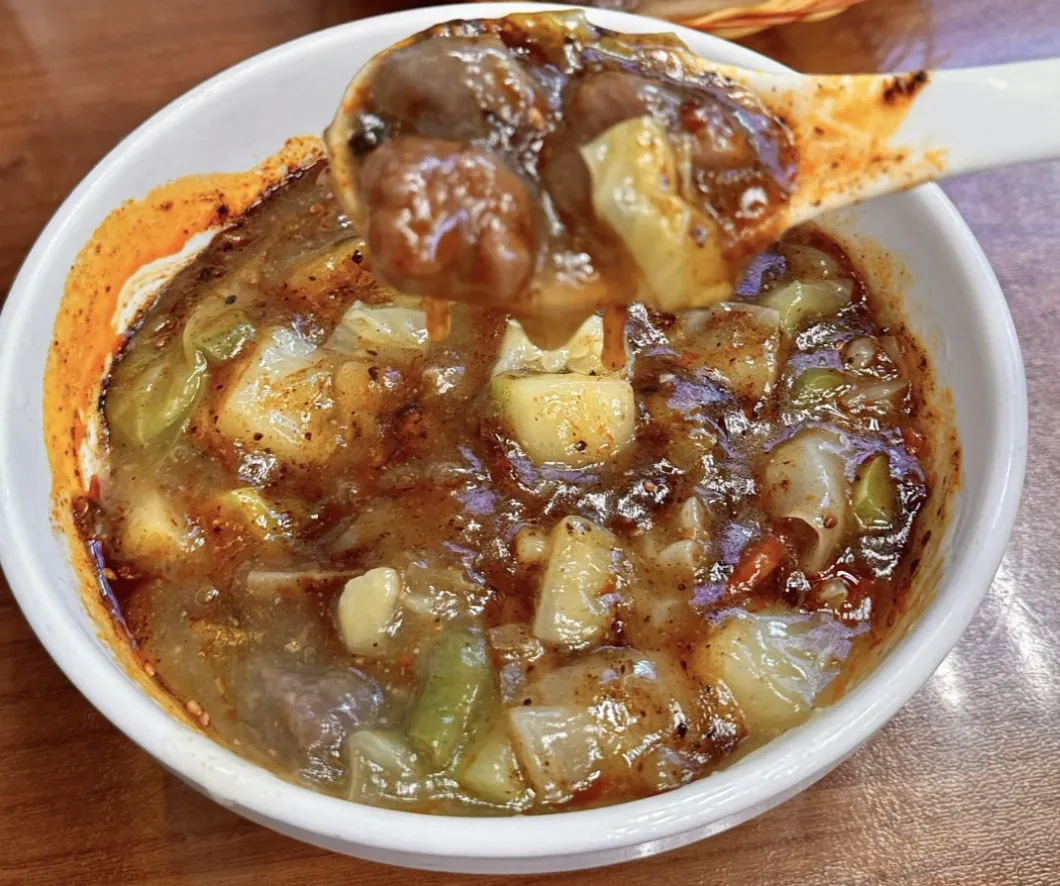
Hulatang (胡辣湯) is Xi’an’s signature breakfast: a thick, starch-thickened soup of soft beef meatballs and chunky vegetables – potato, carrot and cauliflower – generously seasoned with ground white pepper. The name says it plainly: hu refers to pepper, la to heat. The soup is so viscous that the spoon barely sinks into it, and the heat that comes off it is not the oily burn of chili but the sharp, aromatic, sinus-clearing sting of white pepper. The meatballs are springy and tender, the vegetables collapse into the gravy, and locals tear in pieces of mo (flatbread) or dunk youtiao (fried dough sticks) so the bowl has some chew. It is comfort food at its most functional – a bowl designed to get you out the door on a cold morning.
Why Xi’an Does It Better
As a northern breakfast tradition, hulatang splits into two famous families. Henan has the Xiaoyao Zhen style – a smooth, peppery broth named for the town of Xiaoyao – while Shaanxi, and Xi’an above all, does the meatball version (肉丸胡辣湯), a hearty beef-meatball stew that grew out of the city’s Hui Muslim food culture. The Muslim Quarter’s breakfast life revolves around exactly this kind of soul-warming food: stalls firing up before dawn, the smell of pepper and stewed beef drifting into the lanes. The pepper itself is history in a bowl. White pepper reached China through the Silk Road spice trade, and Xi’an, the eastern gateway of that network, has been cooking with it for well over a thousand years. This breakfast tastes like the city’s position on the map.
My First Bowl
The owner asked me one question – big bowl or small? – and before I could answer, the largest bowl on the counter was full. I tore my mo into the soup the way the man next to me was doing and took the first spoonful. The pepper arrived before the flavour did: a clean, sharp heat that opened my sinuses the way a winter morning should. Then came the texture – thick gravy coating my tongue, a meatball breaking apart at the lightest touch, potato and cauliflower cooked soft enough to crush against the roof of my mouth. I was sweating by the third spoonful and I didn’t care. I finished the bowl with youtiao, dipping each piece of fried dough in until it was clean.
Where to Eat It in Xi’an
In Xi’an, hulatang is a morning-only affair. Breakfast shops open around six and serve until they run out – usually well before noon – then close for the day. The best bowls are not in the tourist restaurants; they are in the small breakfast shops of residential neighbourhoods. Sajinqiao, the western end of the Muslim Quarter, and Dapiyuan are all lined with shops doing brisk morning trade, and the lanes around Beiyuanmen hide more. Prices are modest everywhere: five to ten RMB for a standard bowl, a little more if you add a mo or youtiao. For a meal that shapes whole neighbourhoods every day before the tourists wake up, this is as close as the city gets to a daily ritual.
Famous Shops & Century-Old Names
If you want hulatang with a history attached, Sajinqiao is the street to walk. Two of the city’s best-known hulatang houses stand a few minutes apart there, both old enough to count as neighbourhood institutions, both feeding queues of locals before the sun is properly up.
Lao Liu Jia Yiwei Xiang (老劉家伊味香肉丸糊辣湯)
Sajinqiao’s most famous bowl of meatball hulatang carries this name. The soup is thicker than most and the meatballs springier, and the queue is already forming while the street is still dark. It was this kind of little shop I stumbled into on my first morning in Xi’an – the bowl it gave me set the standard every one since has had to measure up to.
Lao Li Jia (老李家肉丸胡辣湯)
A few doors down, Lao Li Jia keeps the argument alive. As old and as beloved as its neighbour, it has a following that is fiercely its own – ask anyone on Sajinqiao which of the two is better and you will start a debate. The differences are small, and only regulars can name them: a heavier hand with the pepper here, a thicker gravy there. The safest plan is to try both and pick a side.
Ordering Tips for First-Timers
Go early. Shops open around six and often run out by ten or eleven; by noon, hulatang has vanished from the streets.
Order a mo or youtiao to go with it. The soup is thick and starchy; torn mo soaks it up beautifully, and fried dough gives it crunch.
Know the heat. This is pepper, not chili – sharp and nasal rather than oily and burning – so even travellers who flinch at Sichuan food usually manage fine. Go easy on any chili oil the shop offers.
Stir before you start. The starch settles at the bottom; the first spoonful off the top is milder than the rest.
Eat it steaming. The pepper fades as the soup cools, so hulatang rewards people who finish quickly.
My Verdict
Hulatang is not a dish you read about before you come to Xi’an – it is the one you discover because your hotel was too far from the sights and you needed breakfast at seven. That is its charm. It is honest, filling and unglamorous: a bowl of pepper, vegetables and soft meatballs that starts the day properly. For under ten RMB you get the city’s oldest kind of energy. I now look for hulatang shops the way other people look for coffee shops. Xi’an begins here.