I fell for tieguo dun on a freezing December night in Xi’an. I had spent the evening walking the City Wall, the floodlights picking out every brick and a sharp wind doing its best to chase me down. By the time I reached street level I was chilled to the bone. A Xi’an local friend of a friend took one look at me and announced the fix: “iron-pot stew.” He steered me off the crowded snack streets into a small restaurant near the Bell Tower – plastic stools, laminated menus, a television in the corner. Ten minutes later a black cast-iron pot landed on a portable burner in front of me, bubbling like it had something urgent to say. That pot rearranged how I think about Xi’an food.
What Exactly Is Tieguo Dun?
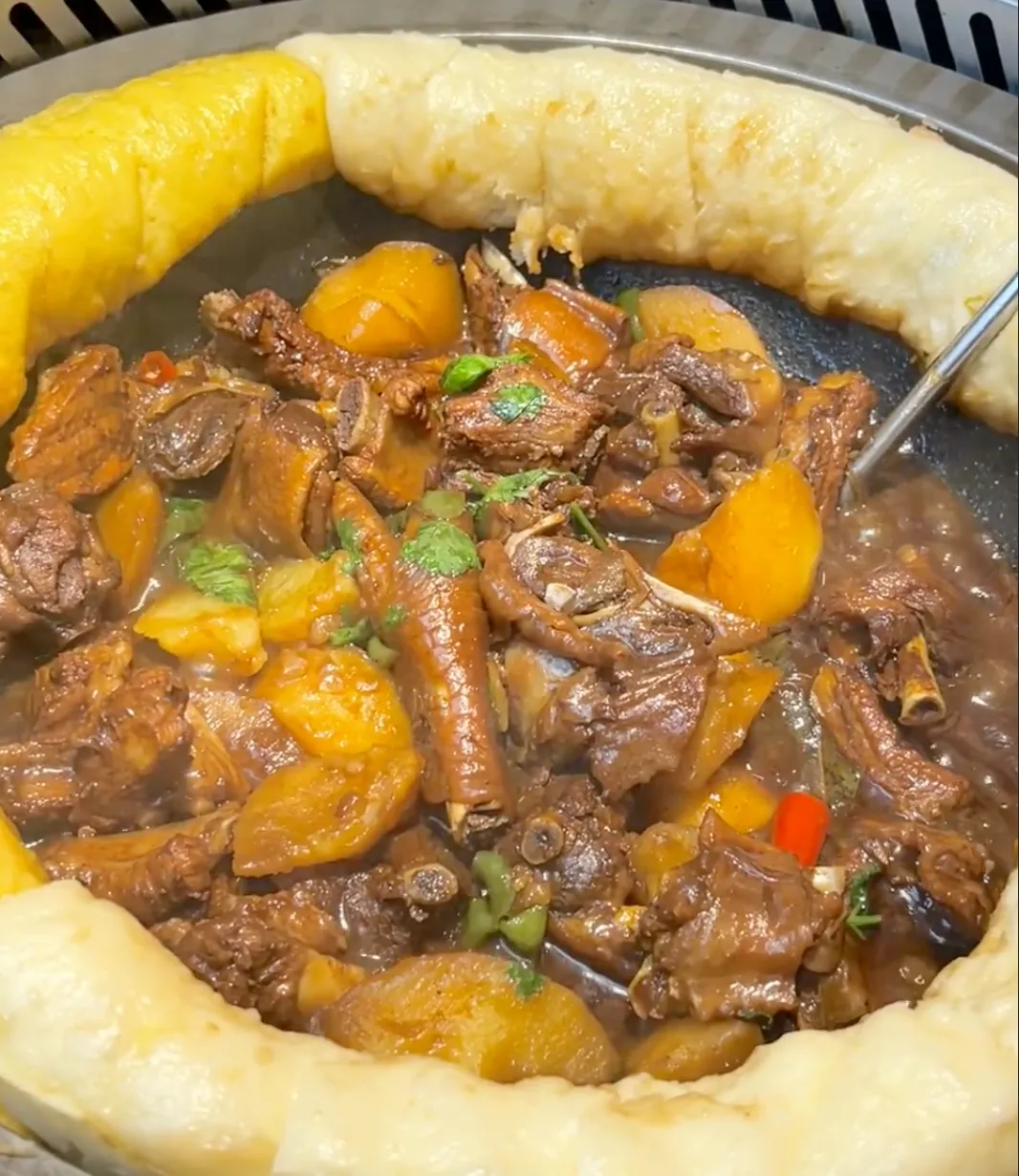
Tieguo dun (铁锅炖) translates literally as “iron-pot stew” – chicken, fish or vegetables slow-cooked in a heavy cast-iron pot until everything melts into one deep, brothy flavor. The pot is the whole story. Cast iron heats evenly, holds heat stubbornly, and gives food a faintly charred edge that Chinese cooks call 锅气 (guōqì), the “breath of the pot.” In a stew, that breath works slowly: chicken turns so tender it falls apart at a glance, potatoes go sweet and soft, and mushrooms drink up the broth until they’re nearly indistinguishable from it.
The pot arrives at your table still bubbling on a small burner, so the flavors keep merging while you eat – what tasted good at the first spoonful tastes even better twenty minutes later. Most places let you choose the base: chicken, fish, or a vegetarian pot for those who skip meat.
Why It’s a Northern Home-Cooking Classic
Stewing in cast iron is as old as the northern Chinese kitchen itself. Winters up north are long and cold, and a single pot that could handle meat, vegetables and broth at once was the practical heart of home cooking – one fire, one pot, one hot meal for the family. That history is baked into the word 炖 (dùn), slow stewing, which in Shaanxi cooking is less a technique than a philosophy: patience, generous portions, no shortcuts.
In Xi’an you’ll find tieguo dun at home-style restaurants (家常餐館) and Shaanxi-cuisine restaurants (陝菜館), places that cook the way a grandmother would. It’s winter food at its most honest – steam fogging the windows, one pot in the middle of the table, everyone reaching in with their own chopsticks. Locals order it when the temperature drops and they want something that fights the cold from the inside out.
My First Pot
The restaurant was small and unglamorous, but the moment the lid came off, nothing else mattered. Steam rolled across the table, carrying the smell of chicken, ginger and star anise. The pot was full to the rim: chicken thighs, potatoes, mushrooms, the broth still bubbling and reducing as we watched. My friend ladled me a small bowl of soup first and told me to drink it before touching the meat. It was rich and clear at once – the chicken’s depth, the vegetables’ sweetness, a warm prickle of ginger and Sichuan pepper that started in my throat and spread downward. The chicken gave way under the lightest pressure of chopsticks. The potatoes had absorbed so much broth they were nearly molten, and I admit I went for those before the meat.
Then came the move my friend insisted on: a ladle of broth poured over a bowl of white rice. That was the moment the whole dish clicked. I kept eating long after I was full, the pot still simmering between us like a small hearth.
Where to Eat It in Xi’an
You won’t find tieguo dun at the snack stalls – it’s a sit-down meal, not a grab-and-go. Look for home-style restaurants and Shaanxi-cuisine restaurants, and in my experience the best ones are not on the tourist trail. They sit in residential neighborhoods, down the quieter lanes around the Bell Tower, along Wenyi Road in the south of the city – modest storefronts where most of the customers are locals. A pot big enough for three or four people runs about 40-80 yuan, which for the quantity of food is genuinely good value.
If you’re with a group, one pot plus a plate of rice each is usually more than enough. Resist the urge to order more – the stew is the meal.
Famous Shops & Century-Old Names
Xi’an Fanzhuang (Xi’an Restaurant) 西安飯庄
Founded in 1929 and certified as a China Time-Honored Brand (中華老字號), Xi’an Fanzhuang is the safest bet in town for proper Shaanxi home cooking – tieguo dun included. It sits on East Street (东大街), a short walk from the Bell Tower. The stews here are slow, generous and never cut corners, exactly the way the dish is meant to be. If you’re traveling with parents or the whole family, this is the kind of restaurant that makes every person at the table happy.
Local Iron-Pot Stew Restaurants
There’s no single century-old tieguo dun shop to hunt down – the dish is home-style and leans on northeastern cooking, so the best tables are simply the ones full of locals. Look around Xiaozhai and the Giant Wild Goose Pagoda, and in the residential neighborhoods where the customers are all regulars. Follow the crowd into a busy joint and you’re almost never wrong: the chicken pot and the fish pot are both honest, cheap and warming.
Tips for Ordering Tieguo Dun
Bring a group. A pot is built for three or four people. Alone, you’ll be overwhelmed within minutes.
Pick your base. Chicken and fish are the classics; vegetarian pots exist, so just ask.
Save the broth for rice. Spooning the reduced soup over plain white rice is the single best move on the table.
Go when it’s cold. Tieguo dun is winter food by design. The colder the night, the better it tastes.
My Conclusion
Tieguo dun is not the dish most people come to Xi’an for, and that’s exactly why I recommend it. It’s slow, generous and warming – the city’s everyday life in a pot, the kind of meal you remember not because it’s photogenic but because it makes you feel looked after. At 40-80 yuan for a whole table’s worth, it’s also one of the most honest deals in town. One practical note: portions are large, so don’t order side dishes before you’ve seen the pot. Winter in Xi’an deserves a hot iron pot; give yourself one, and you’ll understand why locals never seem to be cold.