I first ate yangrou paomo on a December night so cold that the steam from the Muslim Quarter’s food stalls hung in the air like smoke. I had just arrived, backpack still damp from the drizzle, when hunger steered me off Beiyuanmen’s main strip into a lamplit shop that smelled of lamb fat and toasted wheat. Every table held the same quiet scene: men in padded jackets leaning over white bowls, slowly, almost reverently, tearing pieces of flatbread. Nobody was in a hurry. I sat down, and an hour later I understood why.
What Exactly Is Yangrou Paomo?
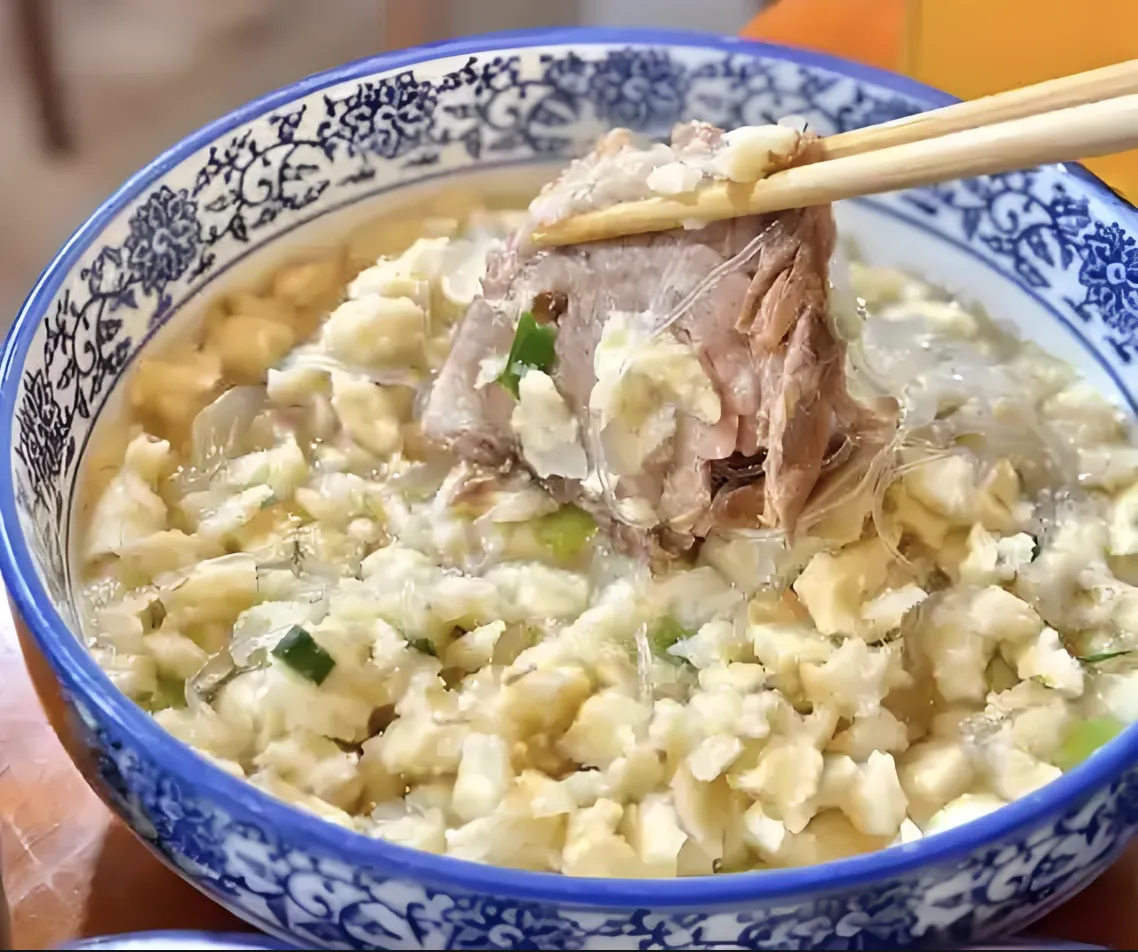
Yangrou paomo (羊肉泡馍) means ‘lamb, bread, soaked’ — which describes the dish, but not its weight. A hard, barely leavened flatbread called a mo (馍) is torn by hand into small pieces, handed to the kitchen, and simmered in a thick lamb broth with soft, melting mutton and a tangle of vermicelli. The bread drinks up the soup until it turns silky outside with a faint chew at its core; the broth is deep and salty, built on hours of lamb bones. It arrives steaming in a white ceramic bowl, and it is a meal, not a snack — generous, heavy, warming, and almost alarmingly filling.
Why It’s Xi’an’s Signature Bowl
Paomo sits at the heart of Xi’an’s food identity the way the city walls sit at its centre. As the eastern terminus of the Silk Road, Xi’an absorbed the lamb-centred cooking of Central Asia and its Muslim communities; the best paomo is still served in the old Hui neighbourhoods of the Muslim Quarter. Locals repeat a saying: if you haven’t eaten yangrou paomo, you haven’t really been to Xi’an. The real ritual, though, is the tearing of the mo. Shops won’t take your bread until you’ve torn it yourself, and the way you tear marks you instantly as local or tourist. Regulars break each piece down to the size of a peanut so the soup soaks through every crumb; first-timers hand over slabs the size of postage stamps and catch the amused glances of the older diners. Legend traces it to a Song-dynasty emperor-to-be, fed soaked bread and lamb by a street vendor while down on his luck. True or not, it fits: this is a dish with imperial ambition and a street-food soul.
My First Bowl
I was handed a whole mo, a plate of sweet garlic (糖蒜), a jar of dark-red chili paste, and a single instruction: ‘smaller.’ So I tore. It took a while, my fingers numb from the cold and warmed again by the bread, but my pieces finally shrank to peanut size. When the bowl came back, the mo had vanished into a steaming lake of lamb broth threaded with soft mutton and fine vermicelli. The first spoonful was pure warmth: rich, savoury, deep with mutton perfume and a gentle kick of black pepper. The bread had gone tender and sponge-like. Between spoonfuls I bit into the sweet garlic — cold, crisp, faintly pickled — resetting my palate for another mouthful. I finished the whole bowl without looking up, then sat back, finally understanding why nobody hurries in a paomo shop. Some foods you eat; this one you work for, and the work is half the pleasure.
Where to Eat It in Xi’an
The Muslim Quarter is the natural starting point. Old names around Beiyuanmen, like Tongshengxiang (同盛祥), have served paomo for generations and make the safest first stop — big, clean, consistent. But I would point you down the lanes the crowd misses. Sajinqiao (洒金桥) and Dapiyuan (大皮院), a short walk from the main strip, are packed with small shops where regulars queue at eleven in the morning, some carrying newspaper-wrapped mo bought from a bakery down the street. The trick worth copying: many locals buy their own bread and bring it in to be soaked. Follow their lead and you cannot go wrong. A bowl runs roughly 25–45 yuan depending on the shop and the cut of lamb — at the upper end of the Muslim Quarter’s menu, and worth every fen.
Famous Shops & Century-Old Names
If you want to taste the dish where it has been made longest, follow the names that have outlived generations of visitors. Four shops in particular are the century-old greats of Xi’an paomo — I would send you to any of them.
Lao Sun Jia (老孫家)
Founded in 1898, in the last years of the Qing dynasty, Lao Sun Jia is the dish’s most celebrated century-old name — a certified Chinese time-honoured brand that has hosted presidents and celebrities for more than a hundred years. It stands near the South Gate (Yongningmen) on Dongguan Main Street. If any single bowl can claim to be Xi’an’s official one, this is it.
Tong Sheng Xiang (同盛祥)
Tong Sheng Xiang, founded in 1920, is the other golden signboard of the paomo world — a Chinese time-honoured brand beside the Bell Tower on West Street. Its house rule is three words: soup fresh, meat tender, bread chewy. For a first, safe, consistently excellent bowl, this is where I would send you first.
Lao Mi Jia Da Yu Paomo (老米家大雨泡饃)
Out on Xiyangshi Street in the Muslim Quarter, Lao Mi Jia Da Yu is the family shop the locals actually queue for, generation after generation: the meat melts, the soup is rich, and at mealtimes the line runs out the door. Go before eleven if you want to sit down with the regulars.
Guo Yuan Zhai Lao Mi Jia (果淵齋老米家)
On Dapiyuan Street, a short walk from the crowds, Guo Yuan Zhai Lao Mi Jia is another Muslim Quarter institution, and the tables are filled more with neighbours than with tourists. Follow the man next to you: point at his bowl, order the same, and you cannot go wrong.
Ordering Tips for First-Timers
Tear it small. The smaller the pieces, the more flavour they absorb. Aim for peanut size; anything bigger marks you as a tourist and gives you a drier bite.
Pick your soup style. Ask for 口湯 (koutang) and you get a richer, heavier bowl with just enough soup for a ‘mouthful’ at the end; 水圍城 (shui wei cheng) — ‘water surrounding the city’ — comes with more broth lapping around the bread like a moat. First-timers often prefer the second; purists tend toward the first.
Do not stir. Locals eat from the edge and barely touch the soup with their spoon; stirring releases the bread’s starch and turns everything into a pasty mush.
Eat it with the sides. Alternate spoonfuls with bites of sweet garlic and dabs of chili paste. One warning: this is a heavy meal. Arrive hungry and skip dinner afterwards.
My Verdict
Yangrou paomo is not Xi’an’s most photogenic dish — it is a beige, steaming, entirely honest bowl. But it is the one I would tell every first-time visitor not to skip. It is the city’s history in edible form: the Silk Road lamb, the Muslim Quarter, the patient local ritual of tearing bread by hand. The price of admission is patience and a fair amount of tearing; the reward is the warmest, most satisfying bowl in the city. Go at lunchtime, watch the regulars, tear slowly, eat more slowly still. Then — and only then — can you say you have been to Xi’an.
Recommended Guides
- Xi’an Travel Guide Home — attractions, food, itineraries & insider tips
- Xi’an Food Guide — must-try dishes & top restaurants
- Xi’an Attractions Guide — all must-see sights, tickets & hours
Keep Reading
- Xi’an Bell Tower: The Ming Heartbeat of the Ancient City — The Ming Heartbeat of the Ancient City — Tickets, Night Views, Nearby Food